When you feel under siege in winter, here’s what you need to do

We’re having a record-setting time in the St. John’s metro area this month. A few days ago, we passed the mark of 170.2 centimetres of accumulated snowfall, making it the snowiest February since record-keeping got underway.
(The photo above, by the way, is of a home in Mount Pearl, and was shared on meteorologist Eddie Sheerr’s Facebook page.)
We’ve definitely been having intense feelings: snowfall after snowfall after snowfall, it all adds up. Schools were closed for three days this week (a bit longer than some parents would like) so that crews can widen streets and dig into sidewalks where kids need them most. (There is an awful lot left to do.)
We’ve had worse winters. A record-keeper for the whole season was in 2000-2001, when a staggering 648.4 centimetres dumped down over consecutive months. That December alone was a record-setter. What I remember also is that the snow just kept piling up and up and up.
I found this essay by Bruce Whiffen, who worked as a meteorologist with Environment Canada (and who was also a respected weather columnist for the St. John’s Telegram; I was his editor there for a few years). It’s a great summary of a wallop of a winter. In it, he has this chart, which presents the data on “snow on ground,” or the accumulation week to week:
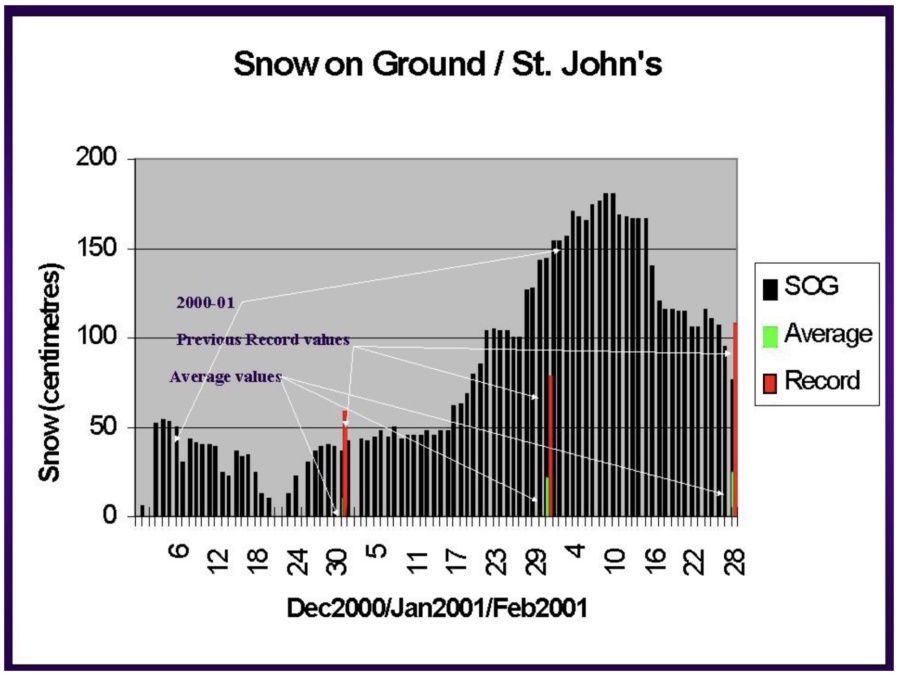
As Bruce wrote (I believe a version of this was published in Newfoundland Quarterly):
The record snowfall of 2000–01 resulted from an abnormally high frequency of winter storms of
moderate intensity extended throughout much of the winter season. Low rainfall and colder
temperatures contributed to a reduced snowmelt, and consequent record snow depth.
During that winter, I was working as a freelance writer, and I wrote a piece for my biggest client — WebMD — about the impact on mental health of repeated storms. Unfortunately, I do not have access to the text anymore, but I do remember some things.
Moyra Buchan, at the time the executive director of the provincial chapter of the Canadian Mental Health Association, spoke movingly about the feeling of siege, that living for weeks upon weeks with relentless weather can exact a heavy toll. That’s what I think a lot of us have been feeling lately.
I also recall the advice that Buchan and others had, or at least some of it. I complemented that by looking for more resources online.
First, remember to eat. Focus on nutritious and hearty food, to nourish and restore the body as it undertakes physical efforts like clearing snow.
Hydrate. Many people forget hydration year-round, especially in the warmer months, but it’s a winter thing, too. Drink water. Your body needs it.
Sleep. This one was a challenge for me at the time, as I was a new father and sleep felt like a luxury. Make sure you get solid rest, again to restore the body and help with your mental health.
Check in on your friends and family. We naturally hunker down in winter, even more so when it’s been stormy. People who live alone are at greater risk of feeling isolated.
It’s snowing lightly as I type this. Another five to 10 cm is on its way. Yay. We may yet finish February as the snowiest month, ever.
It does feel, though, that maybe the back has been broken on this winter. We had a period this week with about six degrees C, enough to soften the snow, lessen the pileup on rooftops, melt the cruddy ice in the streets. Hopefully March will be more lamb than lion.