Cognitive debt: Use a chatbot for writing, but be prepared to pay the price

It happens all the time: the moment when someone realizes they don’t know what they’re talking about — and they know everyone else is realizing it, too.
It could be in a presentation in a boardroom or a conference, or a meeting, or an awkward exchange in a classroom.
In journalism, I saw it during news conferences or official events, and an ordinary question would yield an extraordinary moment: the politician at the podium didn’t know what to say. They don’t call it the hot seat for nothing.
They had a speech, they had memorized their well-honed remarks, but they just didn’t know the material and they were caught with nothing on how to answer it.

Many experienced or bold politicians will find an exit ramp — a joke, a self-deprecating remark or enlisting someone who does know to answer the question — but even then it can be a revelatory moment, a bit like The Emperor’s New Clothes. It’s the the instant when credibility can vanish into thin air.
We’re seeing this more and more as people use artificial intelligence to do their work for them.
I have no doubt people think they’re getting away with something, but the risks are serious. (Look at the egg on the face of the Newfoundland and Labrador government and its consultant Deloitte, after fake citations were found in a commissioned report. Deloitte took responsibility (while insisting AI was not used to write the report itself) and the government recently updated its procurement policies.)
Take a shortcut … and find yourself in trouble
Last year, a research team at MIT, the Massachusetts Institute of Technology, helped popularize a phrase called “cognitive debt” that speaks to what happens in your brain when you get an AI chatbot (also known as an LLM, or large language model) to do your work for you.
A team led by Nataliya Kos’myna released in June a paper called Your Brain on ChatGPT: Accumulation of Cognitive Debt when Using an AI Assistant for Essay Writing Task before it had gone through the peer review process. That process, which I gather is still underway, can sometimes take many months, and we all have seen how quickly AI is changing around us.
The researchers did EEG scans of three groups asked to write a series of SAT essays over a period of time. The first group used ChatGPT, the second group used search engines, and the third group (charmingly called “brain only”) did not use a chatbot at all.
The findings? “Over four months, LLM users consistently underperformed at neural, linguistic, and behavioral levels.” Tellingly, the first group actually got worse as time went by, as they copy-and-pasted their way to completion. The researchers found that the more one relied on an LLM, the less they knew. The “brain only” participants, by contrast, had better scores across the board.
The “cognitive” part of the phrase means the first group didn’t have to expend very much.
The “debt” part comes later. It can be immediate: good teachers can often spot AI straight away, and that happened with the MIT project when two teachers (who were not told anything about the real purpose of the study) reviewed all the papers and often spotted AI-assisted papers.
The bigger debt comes down the road, Kos’myna and team found, because chatbot users are at risk of not gaining critical thinking skills, as well as losing skills. They wrote:
Cognitive debt defers mental effort in the short term but results in long-term costs, such as
diminished critical inquiry, increased vulnerability to manipulation, decreased creativity. When
participants reproduce suggestions without evaluating their accuracy or relevance, they not
only forfeit ownership of the ideas but also risk internalizing shallow or biased perspectives.
There are obvious limitations to the MIT study. It involved just 54 participants, and they were adults. The team’s concern relates to what chatbots can do for younger learners.
In fact, the concern for the impact on children is one of the reasons why MIT released the data before the peer review process was completed.
In other words, a student who relies on ChatGPT early on is effectively cheating themself — of potential, of future skills, of learning how to learn.
A key thing to underscore. The MIT team has pleaded with journalists and others to avoid saying things like you get dumber when you use ChatGPT. This is part of one statement posted online:
Please do not use the words like “stupid”, “dumb”, “brain rot”, “harm”, “damage”, “brain damage”, “passivity”, “trimming” , “collapse” and so on. It does a huge disservice to this work, as we did not use this vocabulary in the paper, especially if you are a journalist reporting on it.
It’s not that you get dumber at all: you just do not develop as well as you could.
Teachers and professors have been inundated for several years now with AI-created work. As one put it, “If you use AI, be prepared to answer some questions.”
There are lots of sayings about shortcuts and how the easy path is not so helpful in the long run — e.g., “a smooth sea never made a skilled sailor” — that feel appropriate to this situation.
Critical thinking is not something you can acquire from a download. You develop that skill over time. I hope today’s young learners pick this up before it’s too late.
Elsewhere this week
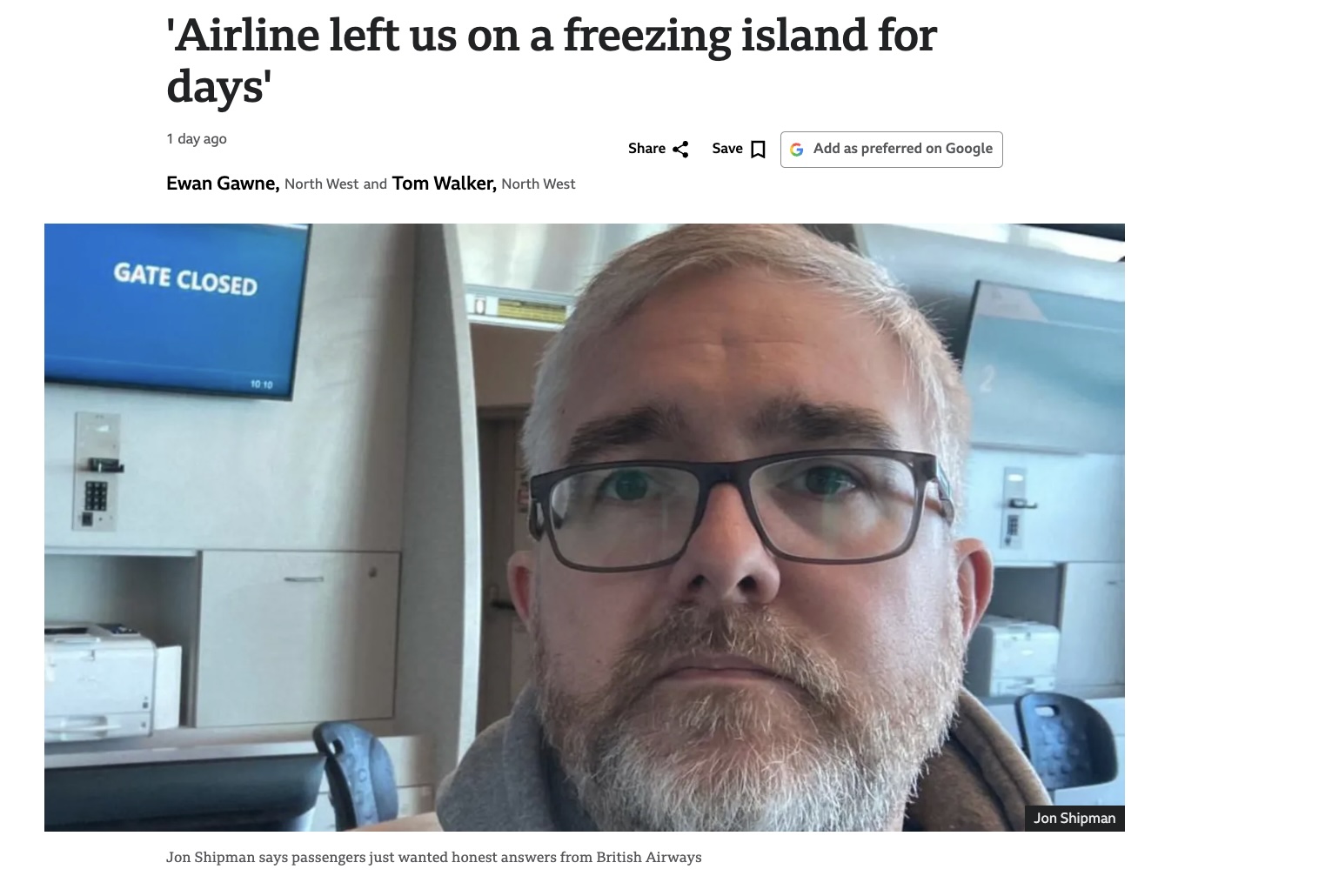
My favourite headline this week is from the BBC, reporting on a Liverpool man’s horror about an unscheduled stop in St. John’s (he was headed to Houston): ‘Airline left us on a freezing island for days.’ As I told a friend in Toronto who was the first to flag the story to me, “It’s not wrong!” It has been a cold week, and there’s more snow (!) in the forecast today. Still, I hope the stranded passengers found a time to, um, chill out.
A battle over race and gender appear to be part of U.S. Defense Secretary Pete Hegseth’s decision to sack the Army’s chief of staff two days ago. Gen. Randy George and others clashed with Hegseth, who days before made an extraordinary move to strike Black and women officers from promotion to one-star generals.
Alcatraz, the island prison in San Francisco that is attracts more than a million tourists a year (I went, and found the experience crowded and underwhelming; you can look at it for free from the harbourfront), will need US $152 million for its first year as a retrofitted secure prison, to meet a goal that Donald Trump set last year.
Liquid Sky was an influential movie in the early-to-mid-Eighties, catching a ride on a New Wave aesthetic and becoming an indie/art house mainstay. Its director, Slava Tsukerman, died this week at 85.
Speaking of obituaries, you learn some things when people die. I knew that songwriter Chip Taylor wrote Angel of the Morning; I did not know a) he also wrote Wild Thing (a big hit for the Troggs) and b) was the brother of actor Jon Voight.
If you’re going to do a painting class, why not do it with goats? Here’s a CBC video fronted by Zach Goudie: