Canadians are getting sour on the economy, but it’s not hurting Mark Carney … yet

Polling data from the last few days speak to a few things. First, Canadians are getting increasingly anxious about economic matters. Second, none of that is hurting Mark Carney — at least, not yet.
There’s a conventional wisdom that economic indicators — and not just that, but public perception of them — are tied directly to a political success and failure.
It’s not always that simple or straightforward, though, and right now Canada’s Liberal prime minister has not been dragged down by an economic gloom that threatens to push much of the world into recession.
It’s enough, indeed, to make me wonder if Carney’s greatest opponent right now is not any individual in Parliament, but economic forces outside.
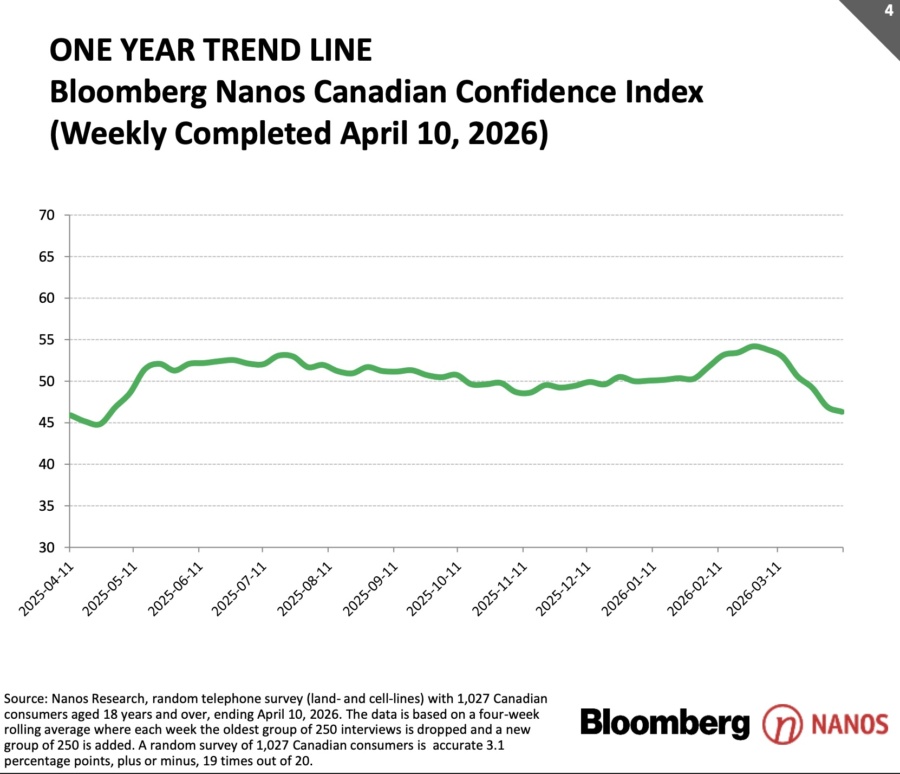
On Monday, veteran Canadian pollster Nik Nanos wrote in a newsletter that Canadian consumer confidence was turning “decisively dark.”
“The deterioration is broad‑based, but expectations are doing most of the damage,” Nanos wrote, citing polling data released Friday. “Optimism about the economy over the next six months has fallen sharply, signalling growing unease about growth, inflation and financial stability ahead.”
He added, “If past patterns hold, today’s gloom may be an early warning of tougher economic conditions still to come.”
At the same time, Nanos reported Sunday that Carney has a decisive lead among other Canadian party leaders as the best choice for PM. (Full release is right here.)
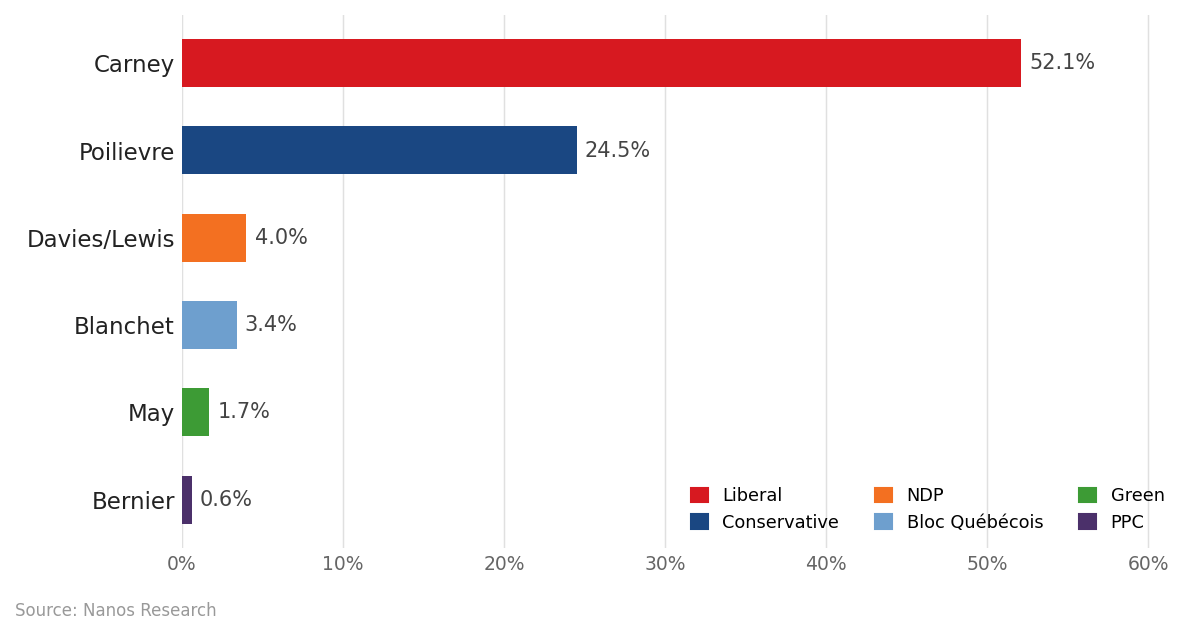
In other words, Carney — whose Liberals squeaked into majority territory this week, after byelection victories and a controversial series of floor crossings — is well ahead of his nearest rival, Conservative Leader Pierre Poilievre.
Let’s double back to the economic data, which shows Canadian consumer confidence not only moving into negative territory, but hitting the lowest point since last May, when Donald Trump’s tariff bombardments were peaking.
This year, it’s also Trump-related, as things started going south in February, when the war in Iran broke out.
Inflation will be an obvious worry to Carney.
It’s freezing-cold comfort, but at least the problems facing Canadians are not restricted to our borders. Indeed, there’s an international chill in the air.
The International Monetary Fund on Tuesday pointed to the war in Iran as the reason for a gloomy reassessment for the global economy, and said things could get significantly worse. From this Reuters report:
Under the IMF’s worst-case outlook, the global economy teeters on the brink of recession, with oil prices averaging $110 a barrel in 2026 and $125 in 2027.
The IMF chose the most benign scenario for its World Economic Outlook “reference forecast,” which assumes a short-lived conflict and oil prices normalizing in the second half of 2026, with an $82 per-barrel average for the year — well below Tuesday’s benchmark Brent crude futures price of around $96.00.
Just minutes after releasing the outlook, IMF chief economist Pierre-Olivier Gourinchas said it may be already outdated. He told reporters that with continued energy disruptions and no clear path to end the conflict, the IMF’s “adverse scenario” looks increasingly likely.
So, apart from whatever domestic issues need to get sorted, foreign winds will be slamming into Canada, perhaps for some time.
Majority rules
It’s been almost a year since Canadians voted in the last election, and the Liberals — not that much earlier assumed to be headed to the ash heap — pulled off a comeback for the ages, albeit with a minority government.
Carney finally achieved a majority this week, thanks largely to five consecutive floor crossings, and capped off with a sweep of three byelections on Monday.
If byelections are — to use an old cliché — a referendum on a government’s performance, Carney was focusing on that as the defining quality of his majority government, not the wheeling-and-dealing behind the scenes that preceded Monday’s wins.
“I think, very clearly, Canadians want the government to govern,” he said Tuesday.
Carney said that with a majority now in place, there will be more of a focus on getting on with government, and less politicking.
He’s also been bolstered by consistent polling results which are in his favour. As the CBC’s Aaron Wherry wrote in this analysis piece, “If recent polls were replicated in an election, the Liberals would win more than 200 seats.”
An obvious hazard is that polls can be fickle — and the same pollsters reporting Carney’s good fortune at the moment are also finding that Canadians are getting quite anxious about the economy.
We’ll see if those competing trend lines will collide.