Why you should thank your local copy editor, with a nod of gratitude from Margaret Atwood
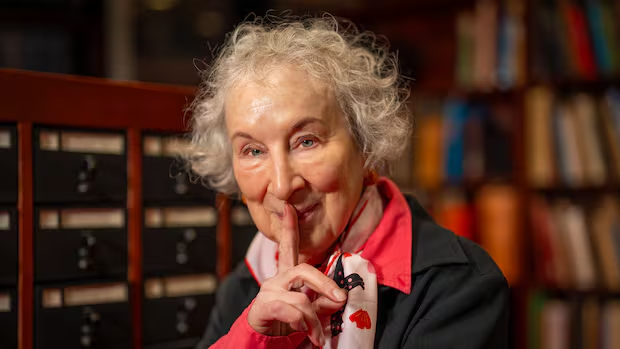
“My parents were less than thrilled when they got the news. I can understand that: a life in the arts is chancy in at least a hundred ways, ninety of them financial. My mother said, ‘Well, if you’re going to be a writer you’d better learn to spell.’ Spelling was not then, and is not now, my strong point. ‘Others will do that for me,’ I proclaimed. And so they have. Thanks very much, copy editors.”
— Margaret Atwood
In her recently published Book of Lives: A Memoir of Sorts, Margaret Atwood writes about telling her parents that a writer’s life was for her.
The nod to copy editors is significant, and I’m sure other copy editors would find it gracious. Not a few would say it’s unusual, too: writers (often rightfully) get praise for their ingenuity, but there’s generally not much discussion of the importance that copy editors play in the editorial process.
Not only that, but the work is largely invisible to the public. As it should be: a glaring error stands out like a sore thumb, while clean, pristine copy — which can involve intensive editorial work before publication — sails by. That’s the unsung nature of the work; the better you are, the less likely anyone in the public will know what you do. (I think people who work in public health will relate to this.)
One of the jokes I often told during my career goes like this: No one ever reads an article and goes, “Wow! That piece was deftly edited!”
The work of copy editors in journalism differs from what literary or manuscript editors do, but there are similarities.
It’s a mistaken notion that copy editors, by the way, fix spelling and that’s the end of it. That, in fact, is just one component of the job.
When I was with CBC News, I had the good fortune of developing and delivering a copy editing course, working frequently with colleagues Janet Davison and Dave Howell, as well as Jane Armstrong and Lara Schroeder. (They’re all legends, by the way.)
In the course, we spent a chunk of the morning talking about the role of the copy editor as they work on a story. Here’s generally how the process breaks down:
Structural edit. Go through the story from top to bottom, and see how it all reads. (Dave Howell had wonderful advice for this part: sit on your hands! By this he meant resisting the temptation to start making tweaks right away. Don’t worry, the same error will jump out at you later, after you’ve read the whole thing.) Is the story complete? Is there a clear focus, and if not, a buried lead? Does it need another voice or more reporting? Are there logical holes in it?
The edit, in full. Now it’s time to edit for grammar, syntax and, yes, Peggy, spelling. This can be a time-consuming process — at least, it takes longer than even some newsroom colleagues believe. (One of the jokes in our course is how irritating it is for someone to holler out for “a quick vet.”) During a fine edit, we go through the details, make sure the math adds up, check on job titles, ensure the facts in the background are accurate, and so on.
A packaging edit. A copy editor focuses on how a story reads, but we also spend time on how a story looks. We put a heavy accent on this, because we know a lot about audience behaviour after all these years. This involves getting the headline right (no one is going to read your wonderful story if it has a drab, grey headline); making sure photos are appropriate, cropped properly and in the right place; and so many details of how the audience will engage with the piece. A copy editor should definitely look at the piece in preview (which simulates what it will look like on publication) before finishing; I can’t tell you the number of times I sailed over a boo-boo before it leapt out at me in preview.
Most of my copy editing days are, I think, behind me. I have a lot of writing I want to do, though, and — like Margaret Atwood — I will always thank my copy editors. They are among the great unsung heroes of the craft.