Happy 80th birthday, David Suchet
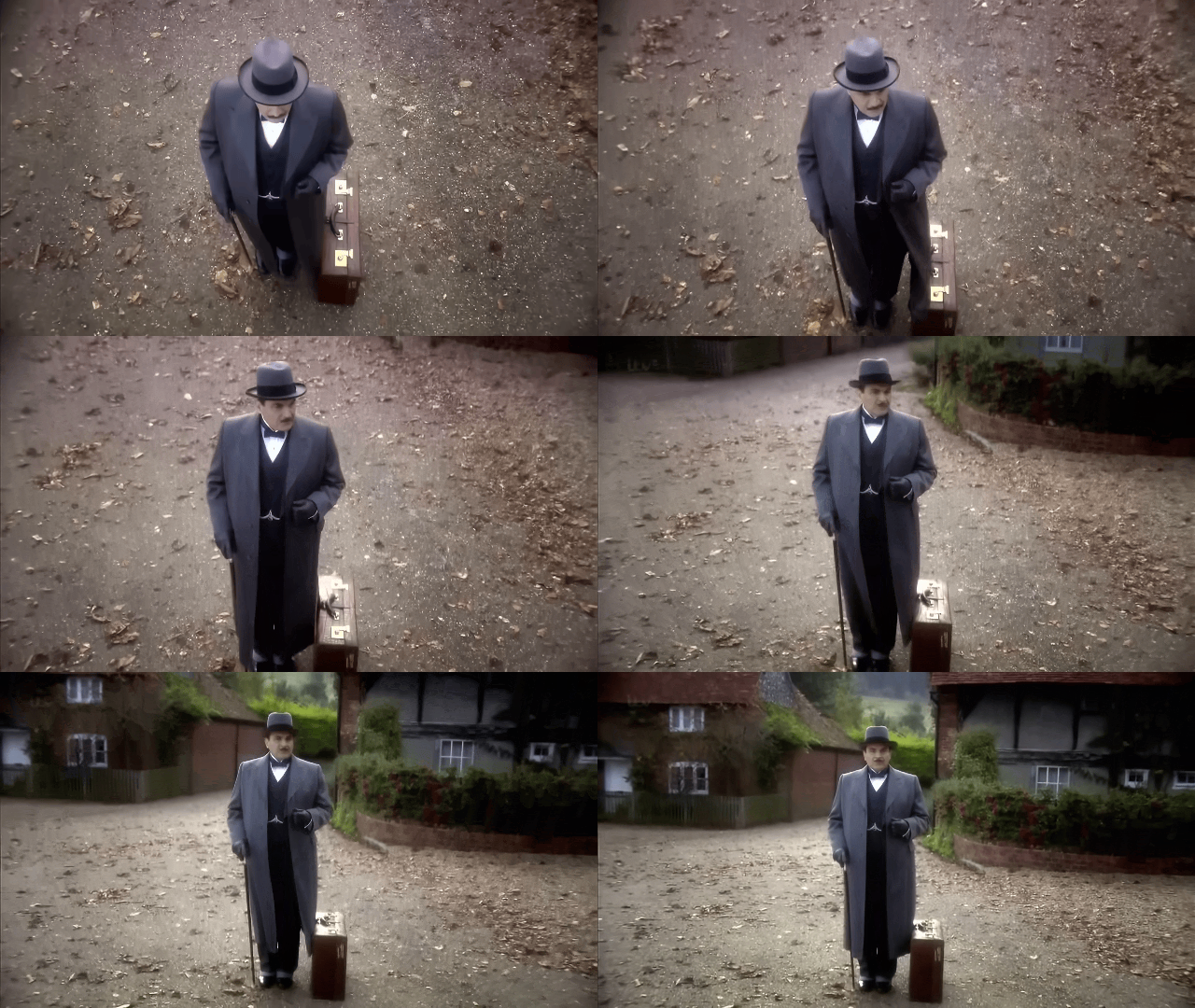
Sir David Suchet was born on May 2, 1946. While he has had an extensive career in the theatre, movies and television, he will always be known for one role in particular: Hercule Poirot.
Suchet was in his early 40s when he signed on to play Agatha Christie’s detective with the egg-shaped head and exacting (if not exasperating) mannerisms, and he knew this would be the role of a lifetime. He was committing to playing the part, it was hoped, in every single short story and novel.
It did indeed take years to shoot, edit and air them all — and that included a hiatus or two while production moved from one company to another. Suchet agreed to the role in 1987, saw the first episodes air in 1989, and finally said goodbye to the role in the 2013 adaptation of (what else) Curtain, Christie’s final Poirot novel.
It took a little bit of time for the adaptations to land over in North America, via PBS’s series Mystery! I remember interviewing the late, brilliant Anne Hart that year about her book The Life and Times of Hercule Poirot, which was a biography of Christie’s character. (Hart, who was head of the Centre of Newfoundland Studies at Memorial University in St. John’s, had had a literary hit several years earlier with The Life and Times of Miss Jane Marple.)
I remember Anne telling me that the Christie estate was pleased with how Suchet was playing the role (and that they had not been particularly keen on Peter Ustinov’s portrayal in a series of movies.)
Anne wrote the two Christie books with the expert eye of a biographer, except that her source material was fiction — and Christie contradicted herself through the years. But through careful reading of the 33 novels and 51 short stories involving Poirot, she fully came to understand the character.
I thought of Anne’s methods when I read a few weeks ago about how Suchet himself prepared for this role. About midway into his Poirot era, he spoke with the Strand, the mystery magazine.
It turns out that his preparation was based on very close readings of the texts:
What I did was, I had my file on one side of me and a pile of stories on the other side and day after day, week after week, I plowed through most of Agatha Christie’s novels about Hercule Poirot and wrote down characteristics until I had a file full of documentation of the character. And then it was my business not only to know what he was like, but to gradually become him.
The work included getting Poirot’s voice right — not to mention the quirky behaviours:
I worked very hard on finding the right voice. I was desperate that he should sound French, although he is Belgian, because everybody believes that he is French. I wanted to move my voice from my own-which is rather bell-like and mellow and totally unlike Poirot. I wanted to raise that voice up into his head because that’s where he works from. Everything comes from there. My voice is very much in my chest and in my emotional area, but his is up in his head. He’s a brain, so that voice had to be raised up and perfected. And then I had to learn how to think like him and how to see the world through his eyes. I had to make his mannerisms and eccentricities not as though they had been put on to be laughed at, but as if they had come absolutely from within that person. I had to make it look real for the audience, yet in a way so that they could find themselves smiling at this strange little man. His mannerisms and eccentricities have to be real and not jokey, so he must never be aware of them or comment on them – even things like putting a handkerchief down on the floor before he kneels. They mustn’t be commented on. This is just what he does.
I did not know a lot about David Suchet before the role. While the series was in its prime, I remember seeing him interviewed with his own speaking voice, and out of makeup, and being intrigued by the transformation, the sleights of hands of his acting.
Not that long ago, I watched a travel documentary with my mom of his journey aboard the revived Orient Express. Mom was also surprised that the real David Suchet was so very different from her expectations; a nod to his talent, I would think.
Before the adaptation of Curtain aired, a complementary documentary called Being Poirot was unveiled. It’s embedded below (although the YouTube thumbnail, somewhat oddly, seems to be a random still from the Albert Finney-fronted adaptation of Murder on the Orient Express). In it, you’ll hear from Suchet about playing the role through the decades. It’s worth the watch.