Saturday digest: Smoke, mirrors & music fans; Epstein and kompromat; just Jack, not John
Happy weekend. Here are some things I’ve been looking at.

Not all that long after everyone hopped on Facebook in the mid-2000s, we saw a phenomenon play out: people indicated they were planning to go to an event, which turned out to scarcely attended. That disappointment has turned out to be a precursor for a bigger problem playing out in the music industry, in which an artist can appear to have a wide following, but there’s not much there in reality.
This is the headline of a remarkable article about the business side of the music industry:
1 Million Monthly Listeners. 12 Tickets Sold. Here’s The Scam.
Author Joel Gouveia digs into the warped math of the music business, starting with case examples of an artist that racked up seven-figure streaming figures, but, yes, just a dozen tickets sold. By contrast, there’s a Canadian rapper who has social media numbers that would appear to be modest at best. But that of course is deceiving:
Artist B—the rapper with the “pitiful” 25k listeners? He just sold 350 hard tickets in Vancouver, 200 in Calgary, and moved 450+ in his hometown of Toronto. He also didn’t just sell tickets; he moved $4,000 in merch in one night.
Gouveia presents an alternate way of understanding followings and suggests using a phrase like “true fans” to market the fans who buy tickets, buy music and buy merch.
Or, as he puts it …
Here is the math that labels don’t want to talk about: You need roughly 75,000 streams to make $300. Or, you need one true fan to buy a hoodie, a concert ticket, and a vinyl record once a year.
Who would you rather chase? 75,000 ghosts or 1 human being?
It’s been very well documented that streaming services pay artists incredibly little for their work. Gouveia argues rewriting the rules … or at least being more honest with artists about how a living can be made:
This isn’t just about making life easier for booking agents (though it would save them millions in bad bookings). This is about rewiring the artist’s brain. The new artist economy is here, and things need to change.
Artists chase what they measure. For the last ten years, we have trained artists to chase:
- Streams (which pay <$0.003)
- Views (which pay $0.00)
- Followers (who rarely see your posts)
To be blunt, a lot of these metrics are smoke and mirrors at the end of the day. Streams, views, and followers do not equal fans.
St. John’s writer Gabby Peyton got upgraded to business class and took her notebook for what she ate. “Eating seafood in Economy? Never! But up in Business Class, definitely. It was spicy, refreshing and flavourful,” she writes.
You might have noted that Russia has been popping up in the various releases of data in the so-called Epstein files.
Here’s a piece from “Alex Finlay” (a pseudonym used by the novelist Anthony Franze) that connects the dots of what has been released re Jeffrey Epstein, Russian intelligence, kompromat, etc. It’s compelling.
A key point:
I find it doubtful that Russian intelligence organized an intricate operation with Epstein at the center to snooker the global elite into a pedophile ring. No. But I am sure elements of Russia’s intelligence services and Epstein had mutual interests and actively helped each other out.
Get ready for a load of Olivers and Laineys in kindergarten in a few years. Those are the leading names that parents in Newfoundland and Labrador gave their parents last year, according to this report by Jenna Head.
Jack was the No. 2 choice for boys; it’s been a popular name for years. Once upon a time, parents named their boy John (you can see where I’m going here) and called him “Jack.” They’ve been skipping that first step for at least a generation now. “Just Jack, thanks.”

As a mid-Sixties kid, I was one of a bunch of Johns growing up. It’s now much less popular. I’m not sure about the data used on the website Behind The Name, but its chart below for the usage of “John” in Canada jibes with what I learned some years ago when I looked into it for a segment on Radio Noon I did with Anne Budgell.
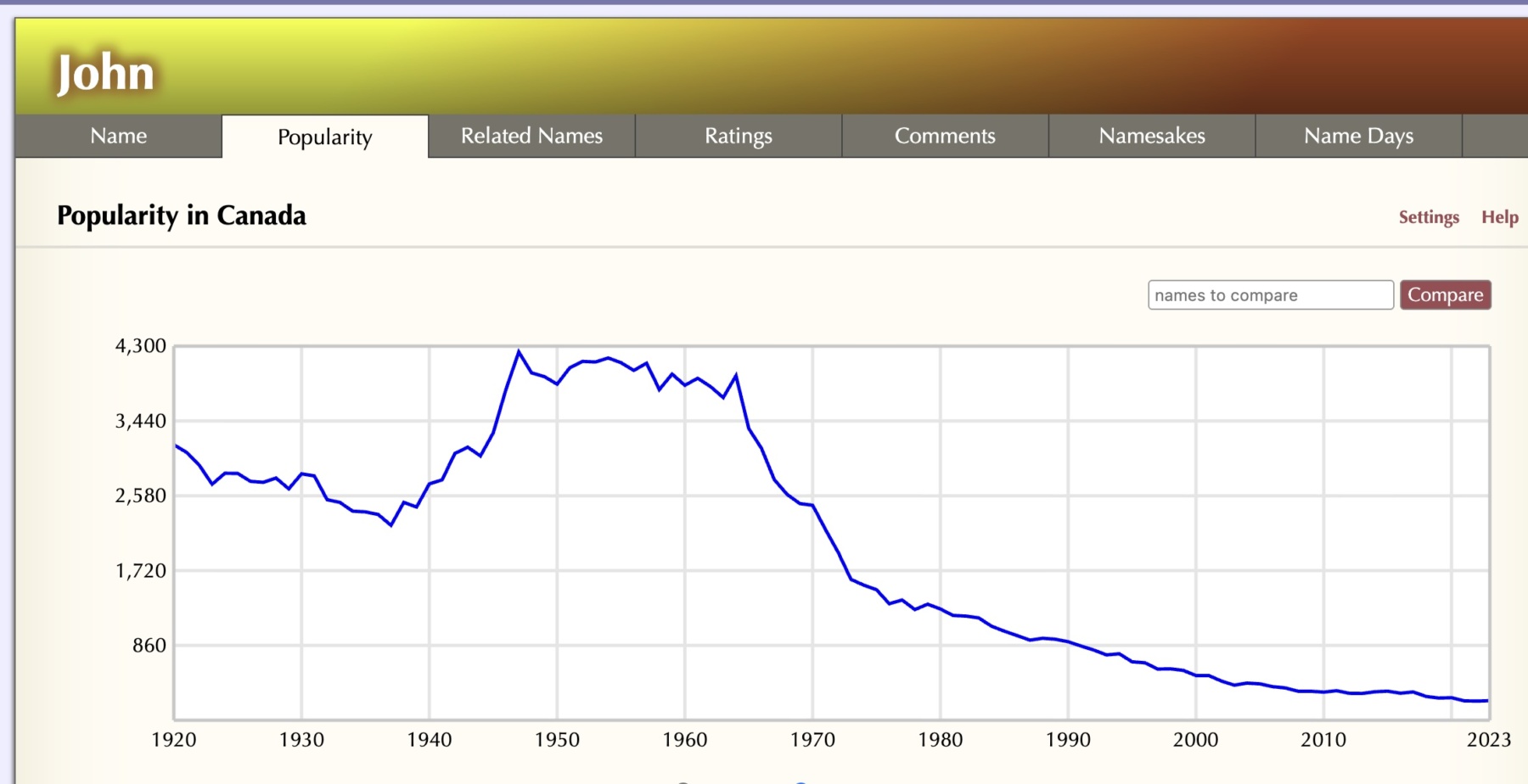
What a downfall! And yet people think John is a very common name.
It reminds me of the Yogi Berra-ism: “No one goes there nowadays, it’s too crowded.”
I’m a bit late to this, but Dean Beeby — one of Canada’s experts on access to public records — had a recent post on how RCMP officers in Nova Scotia were quietly given awards over the mass shootings in April 20, in which a gunman disguised as a Mountie killed 22 people over a 13-hour rampage in multiple locations.
Subhead of the week:
I used to write satire. Current events put me out of a job.
It’s from the novelist and commentator Christopher Buckley, who looks at the world with a conservative eye and has earned acclaim across the political spectrum for his wit. In this essay posted this week, he laments the Trump era — and the loss of politicians who knew that being ridiculed was part of their job.
From the courts, there’s this story by Ryan Cooke, one of the talented reporters I collaborated with over the years. A new story is about a doctor, Marcus Hancock, awaiting a court date. Among the accusation is an allegation that he went to the authorities about his ex-partner’s father, informing the police and DMV he was a) the man’s doctor and b) the man was a public safety risk because of his purported drinking. From Ryan’s report:
The ex-father-in-law met with the Royal Newfoundland Constabulary a few days after getting the notice. He told them he wasn’t an alcoholic, and said Hancock wasn’t even his doctor.
He provided the police with a note from the person he said was his actual doctor of more than 40 years, stating he had never been treated for problems with alcohol. His license suspension was reversed two weeks after it was first issued.