The Washington Post: A dream burned up, like paper in fire
There’s been such a dark cloud over billionaire Jeff Bezos and his handling of the Washington Post, and for such a long time, that it’s perhaps difficult to remember there was a much happier relationship at the beginning.
Bezos bought the Post in the summer of 2013, and there was definitely a honeymoon kind of vibe. The New Yorker last evening published a remarkable essay by a former insider, Ruth Marcos, who for years worked on the paper’s editorial pages.
Marcos also had a front-row seat to the chaos of the recent years, including Bezos’s fateful decision to quash the paper’s endorsement of Donald Trump’s rival, Kamala Harris, in the 2024 U.S. presidential election. The decision — seen as currying favour with Trump (Bezos’s Amazon would soon after pay a stunning US $40 million to license a documentary about Melania Trump, a film that was just now released) — triggered a backlash, with more than 250,000 subscribers cancelling their support.
It was a very different mood in 2013, and for some time thereafter. Marcos writes:
“In the beginning, he was wonderful,” Sally Quinn, the veteran Post contributor and wife of its legendary executive editor, Ben Bradlee, told me of Bezos. “He was smart and funny and kind and interested. He was joyful. He was a person of integrity and conscience. He really meant it when he said this was a sacred trust, to buy the Post. And now I don’t know who this person is.”
She also writes:
What happened to the Bezos of 2013, a self-proclaimed optimist who seemed to have absorbed the importance of the Post in the nation’s journalistic ecosystem? In 2016, dedicating the paper’s new headquarters, he boasted that it had become “a little more swashbuckling” and had a “little more swagger.” As recently as December, 2024, at the New York Times’ DealBook Summit, Bezos expressed his commitment to nurturing the paper: “The advantage I bring to the Post is when they need financial resources, I’m available. I’m like that. I’m the doting parent in that regard.” Not long ago, he envisioned attracting as many as a hundred million paying subscribers to the Post. With these brutal cuts, he seems content to let the paper limp along, diminished in size and ambition.
The Post had a path well apart from other newspapers in those years in the 2010s. While many papers were shedding pages, having long lost the classified and display advertising that sustained the industry for generations, the Post was adding to its coverage, and — like the New York Times and others — reinventing itself with a robust digital presence.
The paper’s stark financial troubles were well in place before Bezos quashed the endorsement (and later cleaned house in the opinion section; Marcos quit almost a year ago). Here’s more from the New Yorker:
The paper had some profitable years under Bezos, sparked by the 2016 election and the first Trump term. But it began losing enormous sums: seventy-seven million dollars in 2023, another hundred million in 2024. The owner who once offered runway was unwilling to tolerate losses of that magnitude. And so, after years of Bezos-fuelled growth, the Post endured two punishing rounds of voluntary buyouts, in 2023 and 2025, that reduced its newsroom from more than a thousand staffers to under eight hundred, and cost the Post some of its best writers and editors.
The layoffs that went out yesterday (after attending a video call, each staffer got an email telling them whether they were in or out) added 300 more newsroom cuts, in effect halving the journalistic staff from the pre-buyout level. Bringing in other departments, Tuesday’s cuts account for about a third of the overall workforce. (Dave Pell, whose newsletter Next Draft is consistently filled with smart headlines, called his latest “Prime suspect.”)
Gone are whole sections and dramatic reductions in others. The local news section (which stalwarts reminded Bezos on social media was the team that broke Watergate) is down to a small fraction.
Former executive editor Marty Baron tells the Guardian in a story this morning: “The aspirations of this news organization are diminished… I think that’ll translate into fewer subscribers. And I hope it’s not a death spiral, but I worry that it might be.”
I have a subscription to the Washington Post. I got it because the paper’s reportage is exemplary and I could justify the expense because it was worth it. (I will note that the paper, columnists aside, has still been picking topics for coverage that must grate the Trump administration.) I am not sure if I will renew it when the time comes.
As for the journalists: one can only hope they find shelter somewhere else. Ron Charles, who got his termination notice while enjoying the gift of fruit the paper had sent to celebrate his 20th year, is witty in this post on Substack, where will continue to write:
How a major national newspaper will carry on without someone on staff to summarize the plots of midlist literary novels is beyond me. But I’ll leave that challenge to the august managers who must now carry The Post forward.
My first reaction to the news was shock and sadness. Then, slowly, I realized this could be a chance to pursue my dream of competing in synchronized swimming.
Now is not the time or the place to assign blame. There are many complicated reasons we got here. Honestly, the worst aspect of this impoverishing, family-wrecking, confidence-crushing ordeal is that it will inspire David Brooks to write an essay about the hubris of American media.
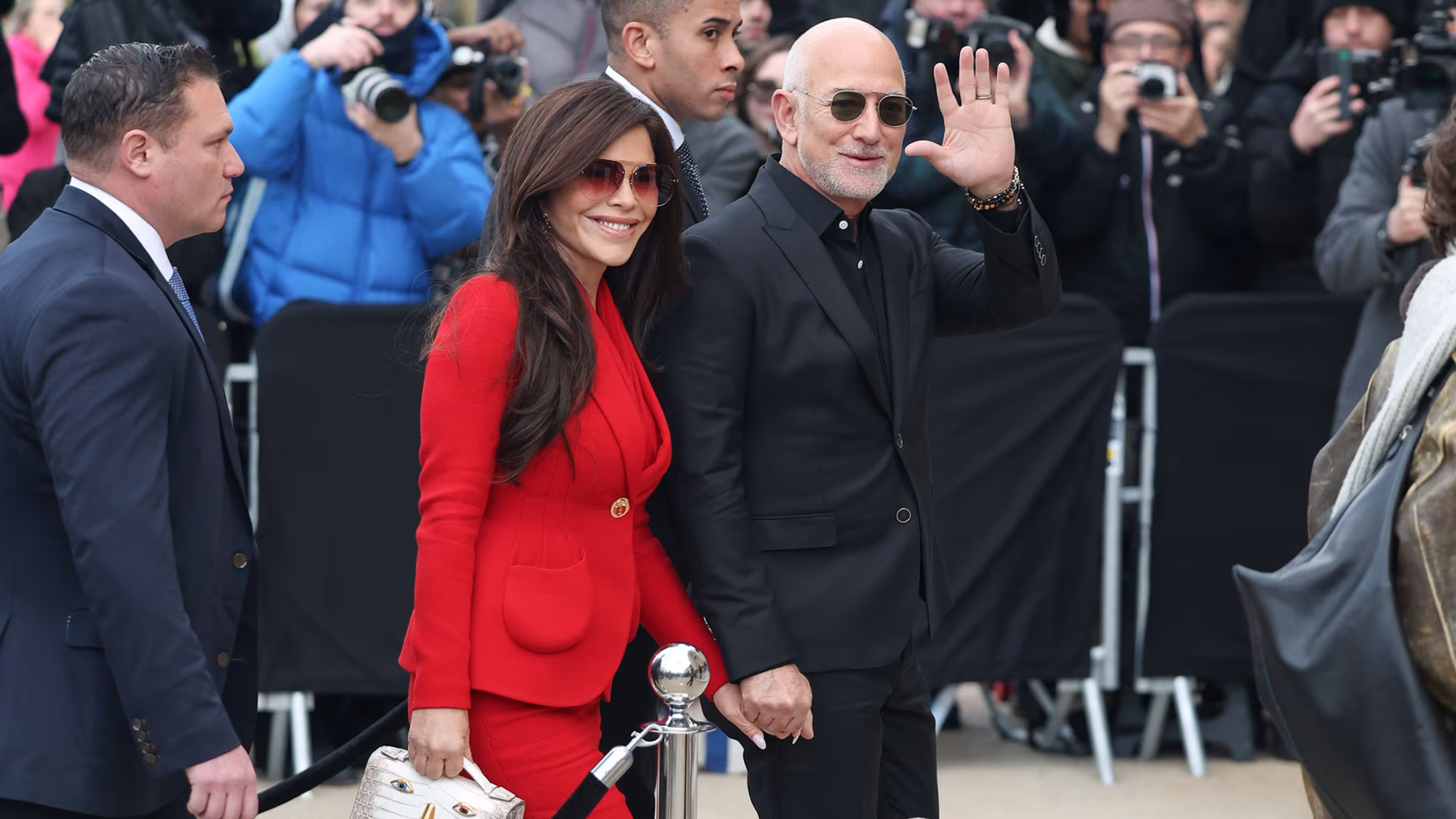
I have not read anything of what Bezos thinks of the cuts. The photo at the top is representative of where he is now with his life; he was photographed with his wife, Lauren Sanchez Bezos, in late January at Couture Week in Paris. CNN’s piece cheekily refers to Bezos now as a “fashion insider.”
Very different from what the Post staff saw more than a dozen years ago, I suspect.
It also appears the doting parent — who made his first millions selling books on the internet, only to preside over the closure of one of the last major book sections in U.S. papers — has put away his wallet.
Here’s today’s cartoon from Michael de Adder, riffing on the Post’s slogan, Democracy dies in darkness.