Divisive by design: The Pitt’s Dr. Santos is an expertly crafted character
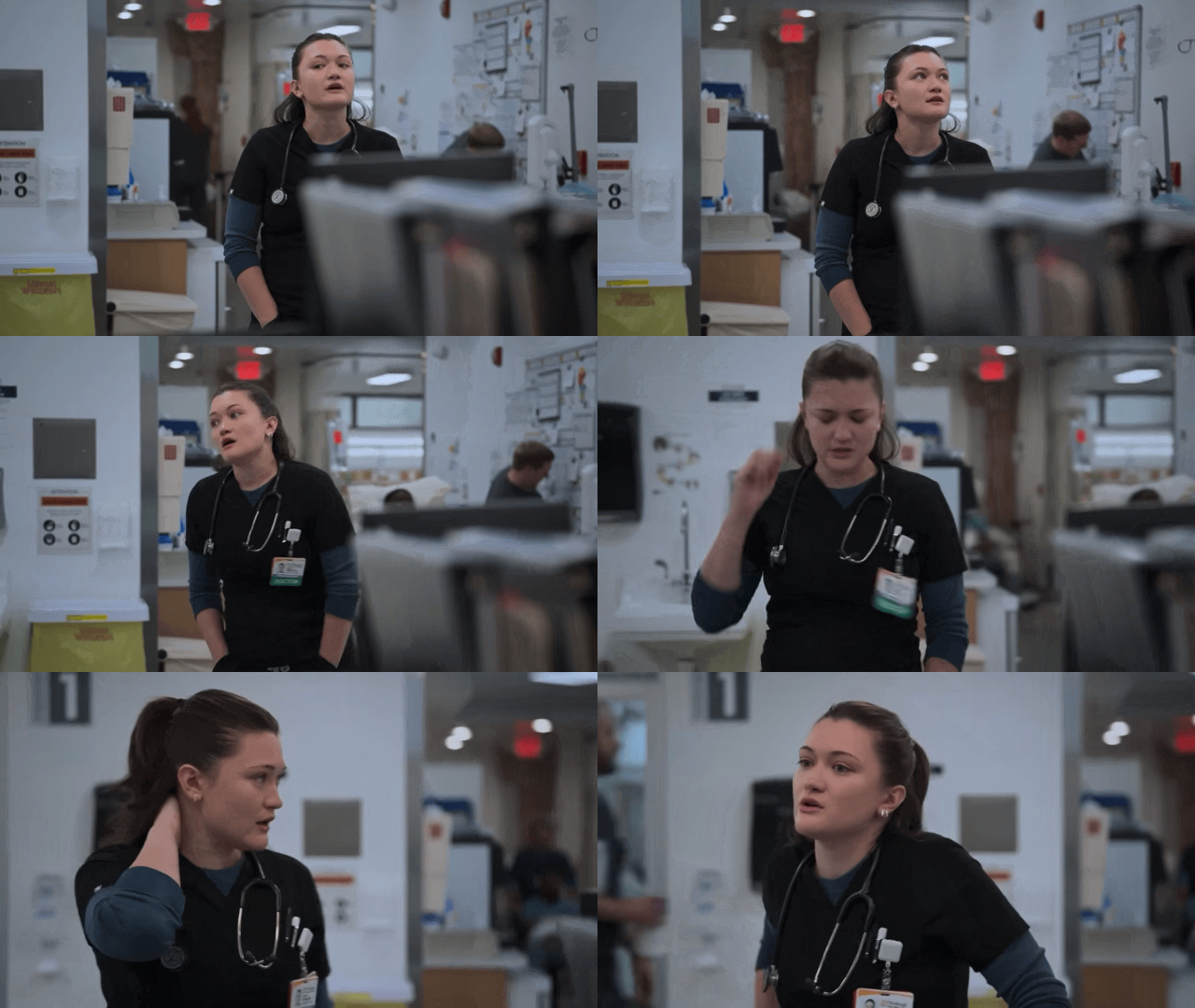
There’s been a mature wave of television shows that grapple deeply with mental health and its complexities (I’m thinking of The Bear and even supposedly light fare like Fleabag), but nothing is like HBO’s The Pitt for exploring multiple storylines about challenging characters and their struggles, all at once.
Many people who watch The Pitt have found Dr. Santos to unpleasant, if not offensive. She doesn’t bother me; as the show continues, it’s clear that her character has always been very carefully constructed, and as layer upon layer is revealed, we see a very human story.
[This post, by the way, is going to be up to date with the series, which is now nearing the completion of its second season. If you don’t want spoilers, feel free to click away.]
The first impressions of Trinity Santos (skillfully played by Isa Briones) are all about confrontation, division and discord. In the fast-paced early minutes, we’re meeting a large cast of a show that takes place in an eternally hectic emergency department, and just learning who’s who takes some attention.
It’s no coincidence that Santos finds a shorthand in these early moments, assigning terrible nicknames to people: she calls Whitaker, who’s from a rural area, “Huckleberry,” and insists on calling Javadi, a student who fainted, “Crash.” When told her nicknames are objectionable, she doubles down, seeming to laugh and enjoy dishing out disrespect.
Some key scenes are cued up below:
Santos is an ambitious intern in the first season, and an exhausted resident in the second. Her attitudes and actions out of the gate are all spikes and rudeness; favours are done not out of kindness but for transactional advancement (e.g., being nice to Javadi, while telling her it’s only to gain favour from her mother, a senior doctor). As a reviewer of the third episode put it:
Trinity bulldozes her way through the episode, self-absorbed and totally unable to read any room, wanting to perform procedures just for her own benefit and fully admitting to Victoria Javadi that she wants to be Victoria’s friend so that Victoria’s mother will help her out. Every time Trinity appears, she becomes more and more unlikable.
Looking back, this was exactly the point. Her unlikability was a storytelling strategy, before any of it was filmed.
Online commentary about Santos is often harsh, but through the first season and even more in the second, we learn a lot about who she really is and how she ticks. In an episode in the second series, we briefly see the scars from self-harm on a thigh, likely building on revelations from the first season that she had had personal experience of sexual abuse (in one jarring scene, she confronts an intubated molester on a gurney).
In the most recent episode from last week, we see Santos — who has been having a very rough day — steal a scalpel. The arc of this story is still underway.
The rough day in season 2 is directly connected to the rough day in season one. In the first season, she has Spidey sense about something being off with Frank Langdon, the handsome, young alpha doc who goes on to belittle Santos in front of others. It turns out her instincts are right: he’s an addict, and he’s been stealing drugs. In the second season, Langdon (who is another complex character) is back after rehab, and Santos cannot accept his return.
Compounding things for her: her relationship with an older doctor, Garcia, blows up (after she learns Garcia thought it was barely anything), and she pushes away Whitaker, who has become her roommate. Watching Santos be unable to tell Whitaker she needs their friendship is painful.
I believe Santos was designed from the start to annoy, and written to offend. It makes what happens later so much more compelling.
Knowing that she would become a whistleblower in the first season, the creative team made the impact of those revelations more dramatic by carefully designing her to be unlikable. Imagine how simplified everything would have been if she had been a goody-good? The tension is so much more amplified because Santos carries so much baggage with her coworkers.
As for the audience, who had been cringing in the early episodes, they saw as the episodes unfurled that there is a strong ethical core inside. Like the other characters, the show gradually reveals there is much underneath the Santos surface.
Over the series, we learn Santos comes from a background without privilege. The Pitt famously does not show its characters outside of the work environment, so we don’t see Santos’s family, and we have only gleaned a few (worrisome) things about her upbringing. I am assuming some additional painful revelations are ahead in the final three episodes of the season.
A telling moment this season came when Santos sings softly to an abandoned baby — Baby Jane Doe, the pronunciation of which by charge nurse Dana Evans (Emmy-winner Katherine LaNasa) has become a thing this year — with no one else in the room. It’s just the two of them, and all guards are down.
People put on masks, guardrails, armour, whatever you want to call it, to get through tough times, even everyday life. Santos has gotten where she is — a demanding and expensive medical education — by cladding herself with emotional spikes. It’s how I believe she has survived.
It’s impressive to watch Isa Briones bring out the nuances of a very well designed character, one we’re still coming to know.
I revisited a news story from last season, when show creator R. Scott Gemmill responded to the overwhelmingly negative reaction that the audience had to Santos:
“I think the fans have reacted the way we had hoped. I thought they were a little harsh on Santos,” Gemmill said. “‘Cause I actually, if anybody on the staff is close to me personally, personality-wise, it’s probably Santos.
“I was like, ‘Yeah, but she’s just trying to find her way. She doesn’t mean it all,”‘ he said, defending the character.
I’m looking forward to seeing more of Santos come to light. Santos may not be the person you’d want to hang out with, but she is a terrific creation of fiction.