Take it from moid: Clavicular may be a clown, but the misogyny of young men is no joke

A young man who believes hammering his face bones is actually making him attractive — and who gets attention by demeaning women, acting like a jerk, getting arrested and rage-baiting millions — has been making me wonder a lot about the state of the world, and our immediate future.
Clavicular is the nom-de-stream of a 20-year-old American named Braden Peters, whose handle has become synonymous with a you-can’t-make-this-up trend called looksmaxxing.

This is a thing that has been part of incel culture, itself something we’ve been living with (and studying) for years. It all gets weirder and more dangerous as the years pass.
Incels get their name from supposedly being involuntary celibate. They typically are young men who loathe and mock women, who are seen as not only rejecting incels themselves but their supposed place of being subservient to men. Over the years, the movement has radicalized young men whose rage at the world has turned to horrific violence. In Canada alone, incel culture has been behind the 2018 van attack murders in Toronto and a murder at a Toronto massage parlour in 2020 so severe it was designated terrorism.
As for looksmaxxing, it’s hard to believe. Use of things like Botox and skin fillers have been eclipsed by more radical approaches. Adherents like Clavicular believe their looks directly determine their wordly success, and that they can refine their looks by gently hammering their bones, and injecting things like peptides into their bodies. (Oh, and meth.)
Hammering your face to break the bones into something more masculine became a thing, as awful ideas often do, on TikTok, and doctors have understandably been alarmed. (“I guess it’s predictable that men want a cosmetic treatment that starts at Home Depot,” said comedian Stephen Colbert.)
Clavicular has been the subject of intense media coverage in the last few weeks and months, in places like the New York Times, the Atlantic, the Guardian, Slate and the CBC News podcast Front Burner, among many others. Headlines like this — Can’t get a girlfriend? Smash your face with a hammer — are common.
The movement has its own rapid-fire slang that seems to evolve continuously. Feeling lost when you hear it? That’s the point!
There are “moids” — men (from male humanoids, I gather) to be mocked, or “mogged,” another bit of slang about being dominating through a direct comparison. There are also “foids,” the female counterpart to moids. I put moid in this article’s headline as my own way of laughing back at these clowns.
Clavicular, who reportedly has been making $100,000 a month, probably doesn’t mind the controversies — indeed, his business model, like many self-appointed influencers, demands continual spikes in attention.
His audience, of course, is not any of the media organizations cited above. It’s the kids, and he talks directly to them.
On Friday evening, Clavicular started a stunt of a month-long stream on the platform Kick. More on that in a sec. Here’s the pretty slick promo he released to social media.
The video was posted elsewhere, with people outraged or just laughing … often pointing out that this feels like a non-funny parody of the Christian Bale character, Patrick Bateman, in American Psycho.

Clavicular is among a generational shift that could not care less what you think … or at least would like you to think that. So, for the next month, he’ll be livestreaming 24/7 on Kick. Oh, what’s Kick? It’s like Twitch, just worse; as this Wikipedia entry describes it, it has “a focus on looser moderation, higher revenue shares for streamers, and the inclusion of online gambling content which has been banned from other platforms.”
When I looked just now, there were more than 16,000 people watching Clavicular sharing a screen displaying some video games.
To keep stirring the pot, Clavicular dips into the open misogny of the male looksmaxxing movement.
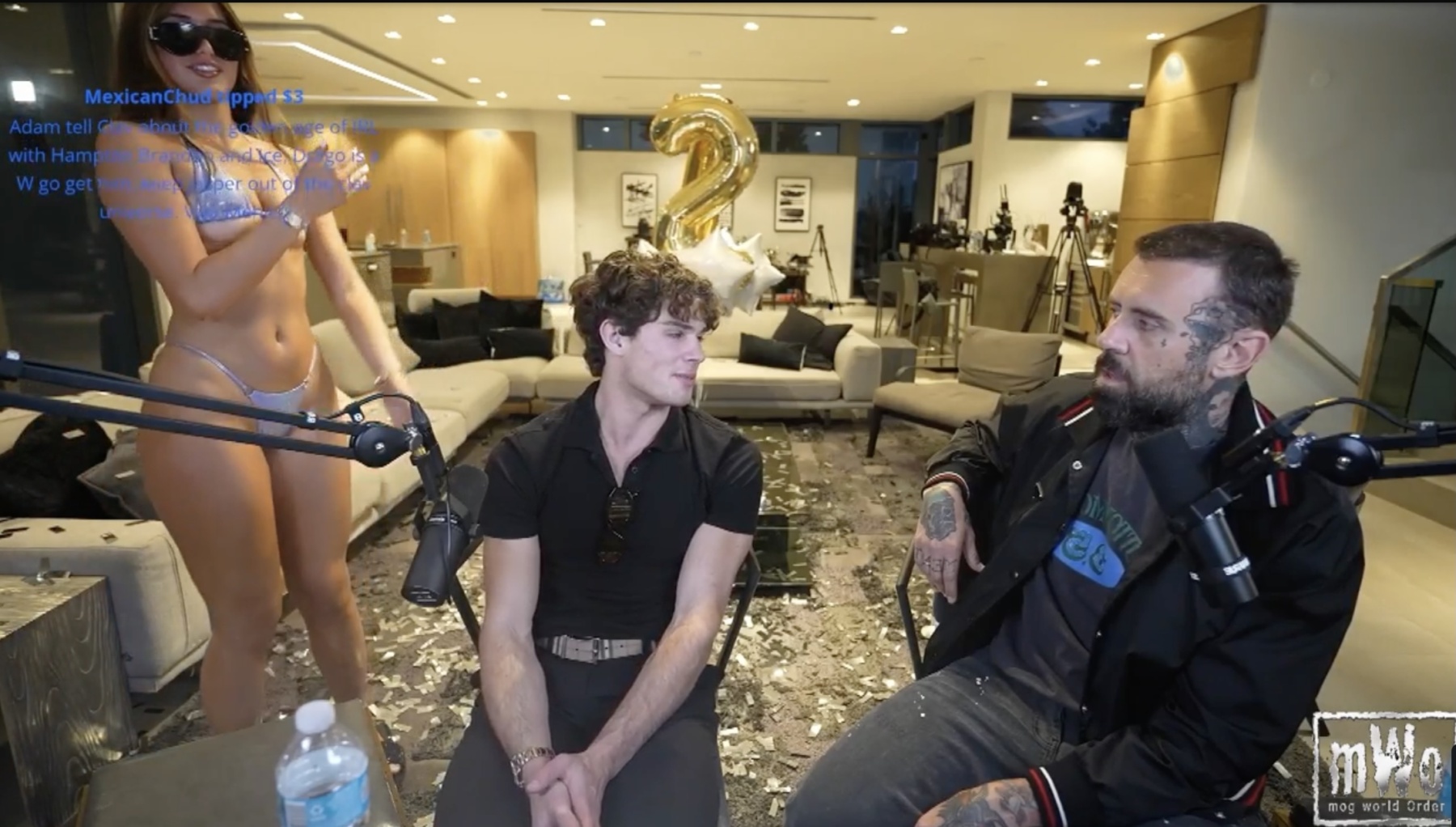
While he says he’s not political, he has had a habit of hanging with stars of the far right. From the NYT (gift link provided):
Just last month, he partied at a Miami nightclub with Nick Fuentes, the white nationalist commentator, and the influencer Andrew Tate — who faces charges of rape and human trafficking — producing a kind of manosphere cloutbomb. (This despite Clavicular, months earlier, criticizing Mr. Tate’s appearance: “Not a good-looking guy by any means.”) In videos that spread widely online, the three men were seen chanting along to the Ye track “Heil Hitler.”
Demeaning remarks about women are standard fare. Here’s an example of how he “dominates” (his word) women on a live video app called Monkey. Within seconds, he finds something offensive to say to a woman before abruptly disconnecting. (A head’s-up: this video is filled with abuse; you can look for yourself, but I am warning you.)
This is what he chose to post after the livestream. It’s outrageous and offensive. We know that rage and high emotions can drive engagement: yes, he’ll piss people off, but he will find kids who will nod along.
Clavicular is tapping into something that’s in the culture, and which needs to be addressed. Young men who are feeling alienated can be very online, can be susceptible to online gambling, can be persuaded into some very antisocial spaces, and can express views about women that might shock their parents or even older siblings.
Consider this.
Research released this month from King’s College London (the pollster was Ipsos) found that Gen Z men (born between 1997 and 2012) were twice as likely as so-called Boomers (born between 1946 and 1964) to have what used to be called traditional views on gender roles. In particular:
- Almost a quarter (24%) of Gen Z men agree that a woman should not appear too independent or self-sufficient, compared with 12% of Baby Boomer men. Among women, agreement was notably lower at 15% for Gen Z and 9% for Baby Boomers.
- Attitudes toward sexual norms also differ sharply across generations: 21% of Gen Z men think a “real woman” should never initiate sex, compared with only 7% of Baby Boomer men. Just 12% of Gen Z women agreed; however, Baby Boomer women and men were aligned at 7% for this question.
None of this is healthy.
None of this looks that good, either.
Let’s finish with a smile. Here’s Stephen Colbert’s take on all this, from earlier this week.
A few things for the weekend
Of all the news stories I read this week, the one about the Saskatoon woman whose partner pulled surgical screw out of her head — this, after she was bluntly told at the hospital to go home — still feels visceral, days later.
Mark Carney has lured four members to the governing Liberal caucus; this story answered a question I had about how that compares with prior PMs.
The world produces more bicycles than cars — by far — in the run of a year. I know that, and many other facts from the hynotically interesting Worldometer.
Good grief, the online world is being flooded by fake videos about war in Iran and the Middle East. (Gift article link here from NYT). All of the following are from generative AI, not newsgathering in the field.


The guitar that David Gilmour played on Pink Floyd albums like Dark Side of the Moon and The Wall sold at auction this week for US $14.55 million. (Gilmour had sold it earlier.)
Milk, eggs, flour … so many variations therein. I spent more than a minute going through this post on Reddit’s Data is Beautiful subreddit:
[OC] A Map of Breakfast based on ratios of Milk, Eggs, and Flour
by u/moultano in dataisbeautiful
Tintin gets the Lego treatment, and it was a Snowy minifig that got my attention the most.

Woof.