The train, the river and the opening of a classic music documentary
Jazz on a Summer’s Day was released in 1959, and was filmed the preceding summer at the Newport Jazz Festival. Its opening moments combine the dappled, reflected sunshine in a harbour with a jazzy rhythm.
The piece is The Train and the River, performed by the Jimmy Giuffre Trio. Have a look, and a listen.
As jazz combos go, the Jimmy Giuffre Trio — at least at that moment of the late 1950s — was unusual: the leader on saxophones and woodwinds, accompanied by emerging jazz legend Jim Hall on guitar and with Bob Brookmeyer on valve trombone. An earlier iteration had a bassist, but by this point Giuffre was playing without a conventional rhythm section, nor with a piano, either. That certainly set him apart from what was dubbed cool jazz, or just modern jazz.
Jazz on a Summer’s Day must have had an impact at the time. It’s still in circulation, and a few years ago I watched it through one afternoon; the performances (Dinah Washington, Louis Armstrong, many others) still resonate, but I also loved seeing the observed moments captured around Rhode Island, and the summery freedom the filmmakers seem to have stumbled upon. It’s also odd connecting this playground of privileged (white) America and jazz, an all-American art form rooted in the struggles of Black musicians and audiences.
Jimmy Giuffre’s performance is remarkable. The camera holds on his face, long and tight, and you see how he manages intense breath control to get through The Train and the River. Giuffre appears to have had an influence, too. Van Morrison decided to take up the saxophone after seeing Giuffre play this song, according to biographer Clinton Heylin.
An odd footnote to add. You won’t find the title of the song on Spotify, if you pull up the soundtrack to the album. Instead, you see this:
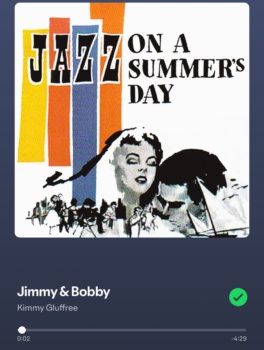
For some reason, the track on Spotify is called Jimmy & Bobby (see above), and there are not one but two errors in Giuffe’s name, which is presented here as “Kimmy Gluffree.” (Glue-free? Yeesh.)
As for Jim Hall, he was also recording on his own by then, and not long after Jazz on a Summer’s Day was released, he started playing with Ella Fitzgerald. He made a well-known comment about the quality of her singing: “I would listen to Ella and tune my guitar to her.”
Hall noodled away during one of Fitzgerald’s most famous recordings, a live 1960 take on Mack the Knife recorded in Berlin, when she forgot the words but saved the night with her trademark improvisations. A classic was born.
Several weeks ago, I joined other late-middle-aged men (sorry for the generalizing, but if the well-worn shoe fits…) and went to a used vinyl fair here in St. John’s. I found some gems, including a pristine copy of a Jimmy Giuffre 3 album called Trav’lin’ Light, which was released in 1958.
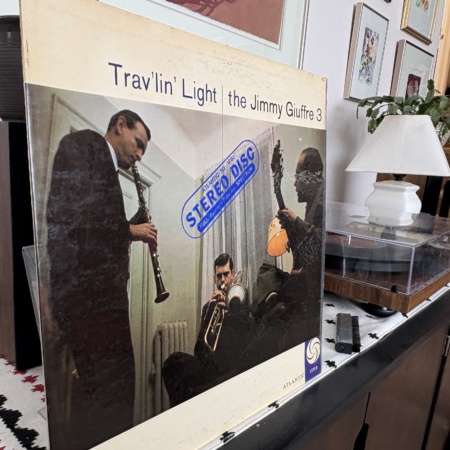
It’s nice to find a quality recording older than oneself, no? I’ve found it lovely for when I want to read on the couch or putter about. I do feel like my dad — he introduced me to Dave Brubeck and many others — at moments like these.
Jimmy Giuffre died in 2008. He was 86.
Jazz on a Summer’s Day is worth the time. It seems to be streaming in different places, and it’s also on YouTube here.