Trivia notes: That time the Stones played Ontario in lieu of a prison sentence

Adam Walsh and I scratched another one for the books today, with the monthly trivia show for CBC Radio’s The Signal. You can listen to the whole thing right here.
I thought it might be fun to recap some of the questions and themes of the show with notes and extra resources.
The Stones’s show after Keith’s heroin bust
I asked listeners why the Rolling Stones gave a concert in April 1979 in Oshawa, Ont., and for whom it benefited. (I erred by the way on air by saying 1978; that was when the trial was.)
In 1977, Keith Richards had been charged after a raid in his downtown Toronto hotel found heroin, and in quantity. While a custodial sentence was possible, Richards avoided that when a judge — finding Richards as guilty of an addiction as a criminal offence — told him to perform a concert that would benefit the CNIB.
Here’s an archival CBC News report.
The judge’s decision contributed to a good outcome. Richards quit heroin for good that same year, in 1979. He describes his addiction and recovery in detail in his book Life.
From a followup question that went unanswered: a character witness for Richards was Lorne Michaels from Saturday Night Live. Michaels flew to his hometown of Toronto for the 1978 trial, as revealed in Susan Morrison’s bestselling biography Lorne.
Mr. Jimmy: A deadly character
We also chatted today about the song You Can’t Always Get What You Want. The character Mr. Jimmy referred to Jimmy Miller, the American producer who worked with the Stones on some of their classic work in the late Sixties and early Seventies. I asked what Mr. Jimmy said in response to the song Mick sung, and the answer of course is one word: “dead.” As in cool. Or, as in a rather similar townie St. John’s vernacular, deadly.
We closed the show with that deadly closing minute or so of You Can’t Always Get What You Want, which is suitably cued up for you below. Bang your own tambourine!
A final Stones question: the name Mick Jagger and Keith Richards gave themselves as producers, post-Mr. Jimmy, was the Glimmer Twins.
Steven Page and Jane St. Clair
Inspired by last week’s Steven Page concert with the Newfoundland Symphony Orchestra, I had a few questions about Page and Barenaked Ladies. First was the Toronto-centric in-joke in the titular character of the song Jane. There was no Jane St. Clair in that shop, at least by that name; Jane and St. Clair are major streets in Toronto.
When Page was collaborating with British singer-songwriter Stephen Duffy, Duffy apparently thought from looking at a map that Jane and St. Clair must be a beautiful intersection. Oh, it’s not, and the humour of BNL came through by going along with a character named after the part of town where car dealerships flourish. Here’s a view from Google Street View:
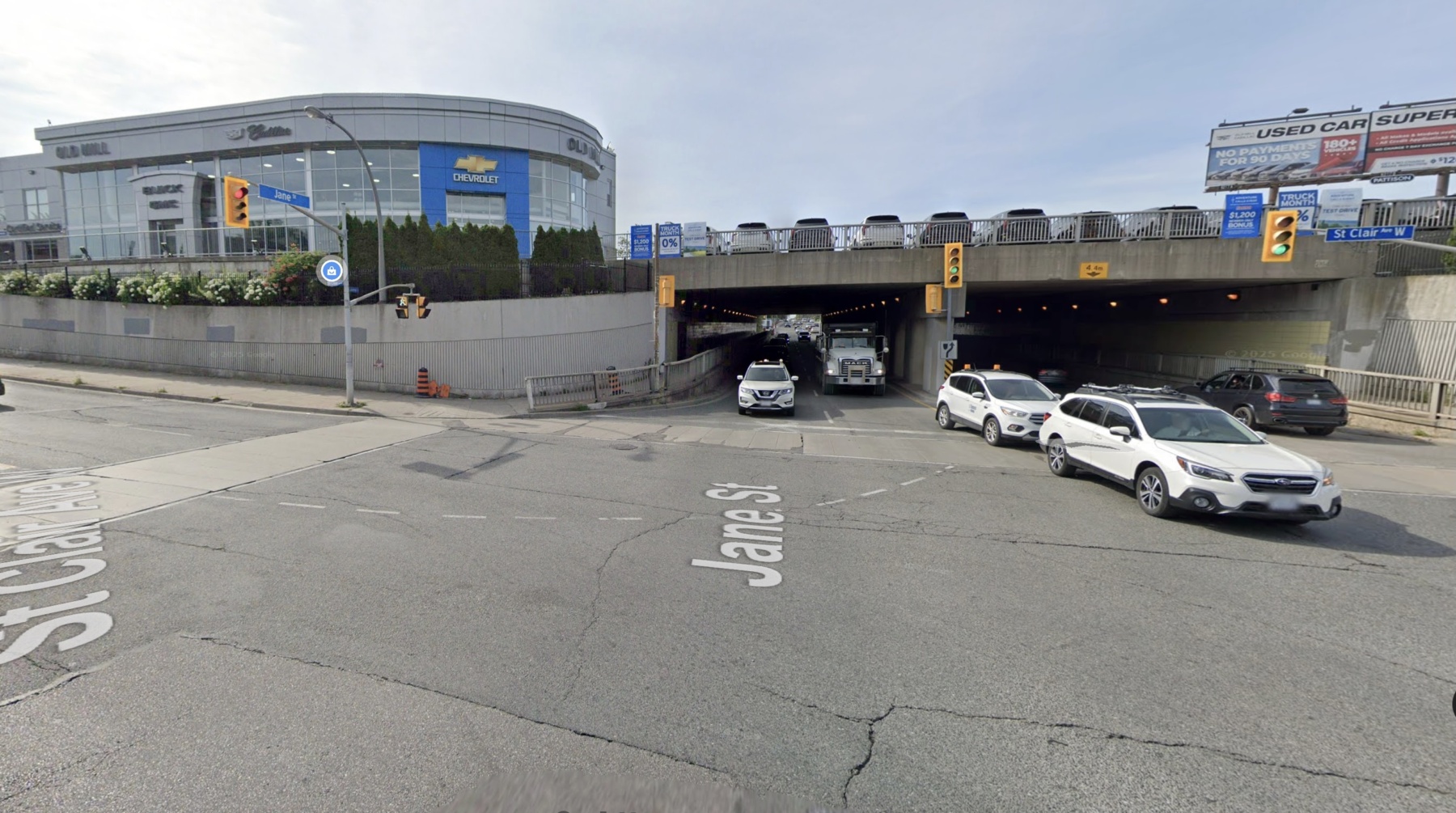
Oh well. Can’t have everything, can you?
Page talked about how Duffy was his teenage songwriting hero, and about how they wrote Jane, in this podcast interview.
Compared to that photo above, here’s the much more alluring song, which is from the second Barenaked Ladies album:
Tim Curry channeled the Queen for Frank N. Furter
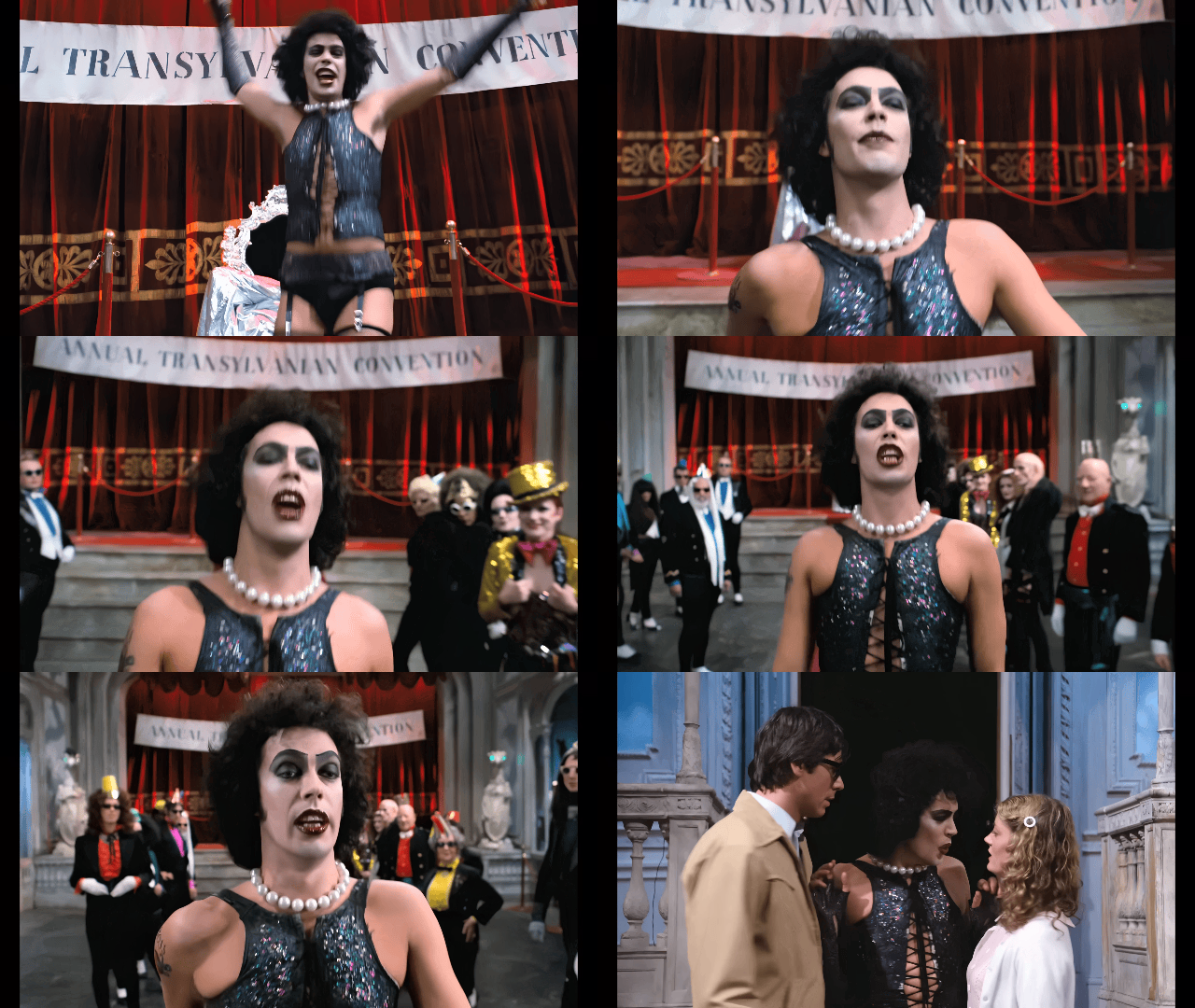
As I mentioned on the blog earlier this week, I recently finished Tim Curry’s new memoir Vagabond. For the show today, I asked what British icon Curry used as inspiration in finding the voice for Frank N. Furter of the Rocky Horror (Picture) Show.
The answer is Queen Elizabeth II, at least by way of a posh fan of the Queen that Curry overheard on a bus. This vintage clip from the Seventies relates part of the story:
If you listen to Curry’s performance, you can’t help but notice those vowels in phrases like “brought down” or “show you around” in this clip, cued up:
Also, as a caller pointed out, costars Susan Sarandon and Barry Bostwick did indeed get quite sick while they were shivering and/or soaking wet during the Rocky Horror production.
There are tons of details in this oral history of how the film adaptation of the musical was made. It bombed on release, but became a cult hit … and is still playing midnight screenings, five decades later.
How Neil Sedaka helped Abba out one time
Thanks to listener Lorna for this one. Neil Sedaka, who died last week at 86, has a songwriting credit in the Abba catalogue. When Abba were aiming to get Ring Ring (a No. 1 hit in Swedish) into Eurovision, they were connected with Sedaka, who enlisted his collaborator Phil Cody.
The English-language lyrics, still anthologized to this day, owe something to Sedaka.
Connecting Confederation Building and Brooklyn
Listener Lana suggested this one. What sitting MHA has a connection with the Brooklyn Dodgers baseball team?
On Tuesday, during her first speech to the House of Assembly since October’s election, Sheilagh O’Leary described how her father, Sean O’Leary, was invited to try out for the Dodgers in 1949.
Thanks to everyone who phoned in and listened today. It’s always a laugh.
I’ll be back on the program in May.