Imagine living in a place where putting clothes on the line is wrong

Earlier this week, I put the first line of clothes of the year out on the line. Now it’s spring, I thought to myself. I made a quick post on social media, and hours later, I was surprised to see that several dozen of people had engaged with the post on Threads.
Flattered, I thought … but it’s just laundry, right?
There is something about a clothesline, though. The one you see above is from last August, when I hung a batch of shirts out, and the early morning sunshine was sublime.
It’s no coincidence that the humble clothesline has been a recurring motif for Newfoundland and Labrador’s celebrated tourism ads over the years. Indeed, the whole genesis of the campaign rests in the fact that in some parts of Canada, clotheslines are verboten.
I remember Noel O’Dea — the founder and former CEO of St. John’s-based Target Marketing, which has been making these ads for more than a generation now — saying that what clicked for him was reading that there were places on the mainland where you’re not allowed to hang clothes on the line.
That’s right: a clothesline is a definite no-no.

O’Dea and team saw things differently. If there were places that were giving a hard no to clotheslines, Newfoundland was going to respond with a soft, warm yes.
A few years into a campaign that started in 2005, Target made this ad, simply titled “Clothesline,” which to me is a golden key that unlocks how the whole strategy works.
You don’t hear a single word in this ad until 39 seconds in. When you do, you hear these words, “Around every corner, around every turn, you’re reminded that around here, not every work of art hangs on a wall.”
Now, let’s be realistic. This is marketing. It’s advertising. Every single element, every frame, is considered, structured and arranged.
But … what connected with audiences with this spot, and others, was a feeling of authenticity and freedom. Fresh air. Something just blowing in the breeze. (Listen to the audio in the ad; the soundtrack is wonderfully edited.)
What O’Dea had been reading about were things like developer covenants, where subdivisions were going up with rules that incoming residents could not do things like hang clothes outdoors.
Those unsightly neighbours!
What’s the deal? Well, some places connect drying clothes with strewing garbage in the backyard. “Unsightly” is a word that seems to come up.
An often unspoken but certainly understood thing, though, is this: class. Putting clothes on a line, for some people, is code for being poor.
Rules seemed to vary from one place to the next in Ontario, and in the 2000s, there were articles about a “right to dry” movement.
O’Dea and team were picking up on all that. If there were places where people felt constrained, going to Newfoundland and Labrador was going to be about letting go. Come for the coastline, fall in love with the clothesline.
And so the clothesline was integrated into cheeky advertising (in the height of humidity, overheated Torontonians were served ads that said “brought to you by Newfoundland and Labrador, where there is no smog”).
“It takes a brave client to allow a clothesline to be a metaphor for an entire province,” O’Dea told the trade publication Strategy in 2008.
They kept at the theme, and that year put up a rather complicated superboard along Toronto’s congested Gardiner Expressway, offering another reality: refreshing breezes with colourful quilts on the line. This time-lapse video shows how it was put together.
Ontario, by the way, introduced legislation to ban the banning (stick with me here) of clotheslines.
Nova Scotia passed what’s called the Clothesline Act in 2010.
There seems to be a patchwork around the country — which does bring that quilting metaphor to mind — in terms of what you can and can’t do with clothes outdoors. In B.C. (I’m reminded by my friend from Vancouver who once told me that everything changes at the Rockies), where what are called strata corporations (think condo board, but a little different) have set rules. In 2012, it was estimated that a million people in B.C. were prohibited from hanging clothes on the line.
I’d go mad.
We’ve been putting clothes out on the line for decades, at both the houses we’ve owned. Yes, it saves on electricity (the first law in Ontario dealing with this was the Green Energy Act), but honestly, and I can pinch a penny, it’s not the biggest motivation. We just love how clothes feel and smell after they come in from the line.
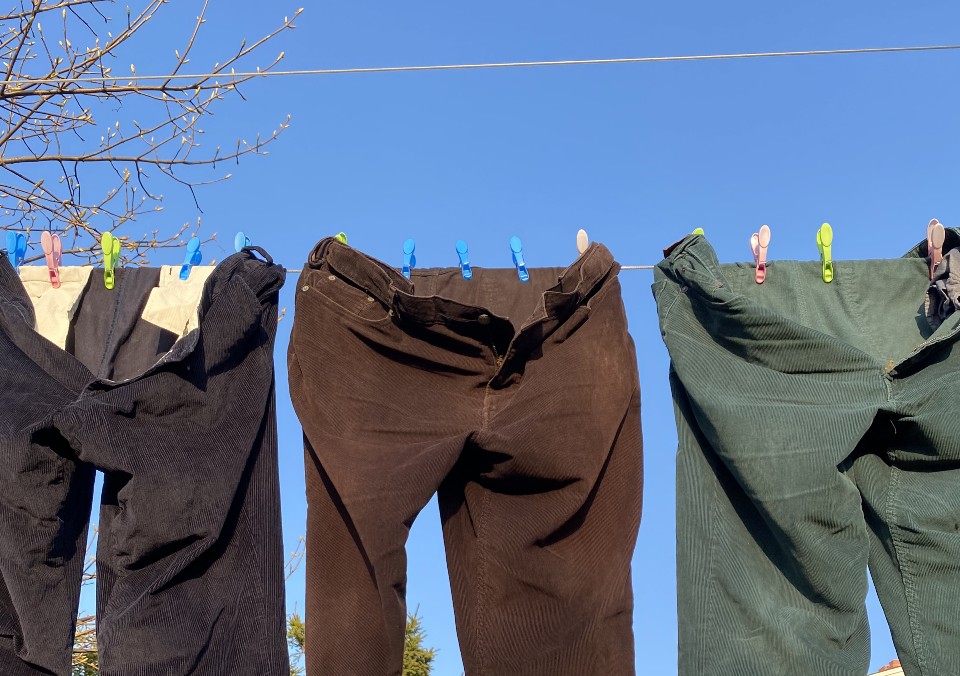
I’ve read that some people find clotheslines to be aesthetically abhorrent. I find them aesthetically splendid.
As chores go, hanging our clothes on the line is the closest for me to pleasure itself. It fills the senses. You touch the fabrics, see the sunlight, smell the air. It’s grounding. When neighbours walk along the path near our house, it’s an opportunity to say hello and be convivial. It’s human.
It’s also a cultural thing. In 2007, the federal government surveyed Canadians about use of clotheslines and drying racks, and found that people in Newfoundland and Labrador — at 73 per cent — were among the heaviest users.
I hope that continues, and not just for the sake of assuring overheated Ontario tourists hoping to catch a fresh breeze this summer.