My mom has Alzheimer’s and lives in the moment. Why not make the moment wonderful?
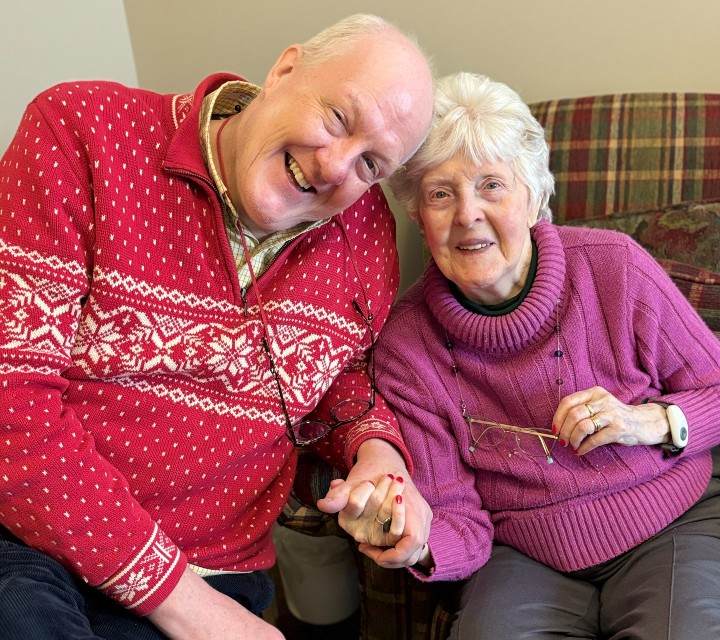
I can tell my mom’s mood from 20 paces. I often see her in the corridor, leaning on her walker, and she turns as she hears me call her name.
Her face might break your heart: it’s filled with anxiety, sometimes fear. “Oh, John, thank God you’re here,” she will often say.
My mother, Sheila Gushue, was formally diagnosed with Alzheimer’s almost two years ago, and several months after that, she moved into a memory care floor here in St. John’s.
A scene like the one above has happened many times, especially after supper, when I arrive to spend some time with her before bed.
I’ve learned what to do, and quickly.
I’ll guide Mom to her room, give her a hug, reassure her and gently change the course of conversation. I’ll get her seated in her comfy chair, put on one of her favourite shows — Gardeners’ World, which streams on Britbox — and (this is key) make a little mug of hot chocolate.
While the milk is heating in the microwave, I’ll drape her in a quilt or a blanket. I’ll compliment her on how pretty she looks.
By the time she has had a few sips of soothing hot chocolate, Mom is usually back to her old self. “And how was your day?” she’ll say, as she leans to me with a smile.
The anxiety has (for now) drifted away. She doesn’t remember what was causing distress.
Alzheimer’s does many terrible things to a person. One of them is stealing the brain’s ability to make short-term memories consistently, and allow them to be accessed.
That’s why many people with Alzheimer’s, and other dementias, often cannot remember, say, what they had for lunch, or if a family member had visited earlier in the day.
It’s a tragic sensation for many families, as they come to see their loved one slip away, and live in a way that seems increasingly disconnected from reality.
But as we care for my mom I have come to see an opportunity.
She’s living in the moment, every moment.
That made me think: why not make the moment wonderful? Why not make it happy, so that she feels that happiness? Why not make it comfy and joyful, so that she feels that too?
Hot chocolate for the win
I gleaned this insight not long after Mom moved into care. The staff there are terrific, but they cannot be with Mom all the time.
Sundowning is the term often used to describe what happens with Mom in the late afternoon. It’s very common, and marks some behavioural changes that someone with Alzheimer’s feels at that time of day. (Many people also call it sunsetting.)
For Mom, one day can be different than the next, but it often involves a sudden onset of agitation. It might involve anxiety, confusion or restlessness. Mom will take to her walker, and often scan the corridor on her floor. Sometimes, she can lose her sense of place — another effect of the disease’s attack on the hippocampus.
Alzheimer’s is a very tiring disease, and we’ve seen this impact on Mom. By the end of the afternoon, she is, well, exhausted. Her ability to process things cognitively is rapidly declining by the time supper is served.
We all want to make everything as calm, warm and happy as possible.
The small hot chocolate serving started as a way to give Mom something she always loved — cocoa was medicine when I was a little boy — and there’s science behind this, too. Carbohydrates are known to have a calming effect on brain chemistry, and this definitely applies with Alzheimer’s. Chocolate has caffeine, so it’s a small spoonful of mix in her warm milk. From what I see, the boost in serotonin comes just when she needs it the most.
Why I’m writing this
We’ve been living with Alzheimer’s in our family for a while. I’ve been wanting to dig into some of our experiences, and I hope to write some short pieces that reflect this stage of our lives.
For anything I write, my mother’s dignity and wellbeing are paramount to me. I never want to put that at risk, though I also want to relate what we’ve learned, how we’re coping and how she is doing.
While Sheila’s cognitive abilities have declined — her ability to reason, her ability to make decisions, and so on — she is still herself. We do indeed see some personality transformations for short times, and they’re not a pleasure to witness, but even at her most difficult moments, I know she’s still Sheila. She still knows who we all are, and she lights up when she sees us. We’re painfully aware that this will likely change.
Alzheimer’s is a brutal disease. But like everything in life, there are good times with the bad, and opportunities with the challenges.
My mom is still lovely. It’s part of the painful process to see her capabilities diminish. My job is to make sure the last of her days — that is, every moment possible — are as free of stress and pain as possible.
I want to write about these experiences for a few reasons. First, I’ve been very grateful for the work of the Alzheimer Society, whose resources have helped me better understand the disease, what it does and how it manifests itself, not to mention what family and carers need to know. I want to contribute to the resources that are there; I know I would have benefited from reading something like this when Mom’s problems were coming to the fore. Even now, too: I regularly seek out perspectives, and have had many conversations over the months with others. Sharing knowledge and perspectives is important.
Another reason is that my mom was keen on science. Chemistry was her passion as a student, and through her career she had a great respect for clinical work and medical research. (She worked in communications for Memorial University’s medical school in the Seventies and Eighties.) She has always been a champion of my writing, and while I now generally avoid subjects that may that may trouble her, we have talked about the disease, especially in the earlier months of her diagnosis.
Mom has been aware — especially when she is lucid, which is usually in the morning — of her condition. I have always been struck when she will ask something like, “Why is my brain playing tricks on me?” I try to provide ease in moments like that.
Through my writing, I want to explore how we’re navigating all this, what we continue to learn, and how we are trying to make the most of an unavoidable situation.
I love my mom, and I truly feel fortunate that I’m able to be part of this stage of her life. I see my primary role in life right now in making her moments marvellous.