Yes, and: How improv comedy helps me with my mom’s Alzheimer’s
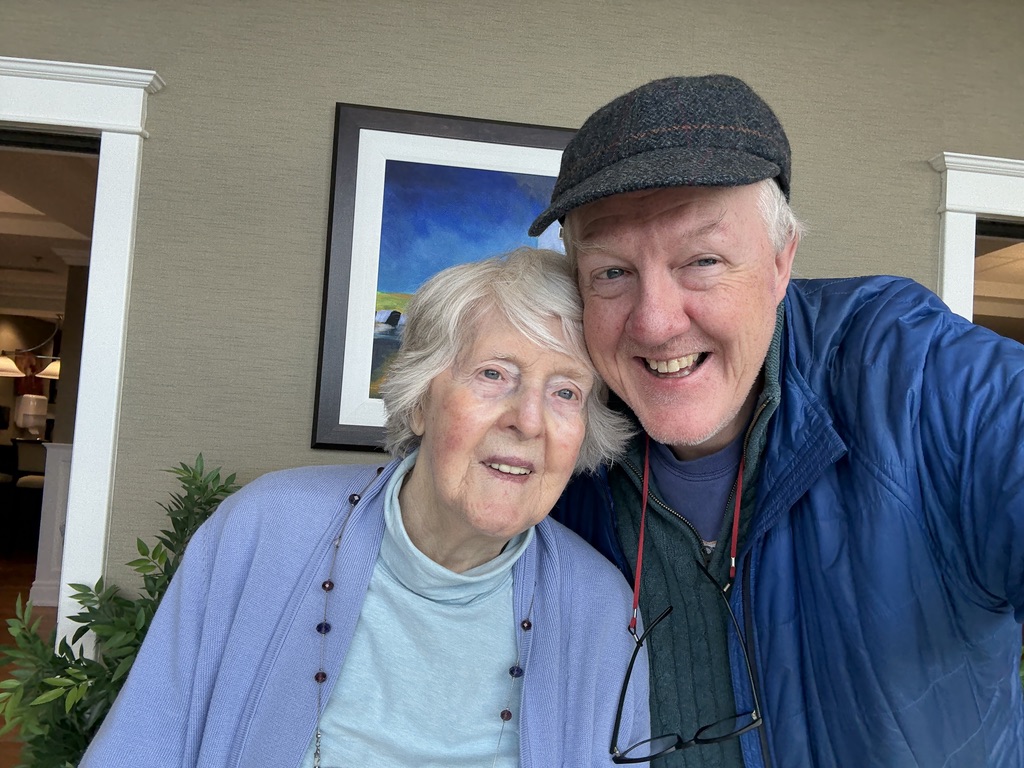
It might seem unusual, but I’ve been leaning into the main rule of improvisational comedy as a way of helping my mom, especially in moments when her Alzheimer’s disease is posing a challenge.
A few things to explain. Even though I haven’t done much improv myself, I love the field and have read a lot about it. (In fact, I’m in the midst of another book, Sam Wasson’s Improv Nation, which is about the roots of a comedy form that has influenced entertainment around the world.)
The principle of improv comes down to two words: Yes, and…
They’re both important.
The “yes” means that if the person who starts a sketch — remember, it’s all being made up on the fly — the second person agrees. So, if someone were to tell me they were, say, an alien, I would go along with it,
The “and” means that the second person builds on that premise. The alien part is accepted, the second person says something (“We’re out of leaders,” maybe?) and, boom, a scene is underway.
How does it work? Here’s an interview with Tina Fey, who learned (and then taught) improv as part of a great comedy tradition.
What does this have to do with Alzheimer’s?
Well, very soon after Mom’s diagnosis, when I was reading what I could and asking questions of clinical experts and friends with experience, one thing kept coming up, albeit phrased in different ways.
Don’t disagree.
Don’t contradict.
Go with flow.
Keep paddling along.
Nod and just go with it.
There are moments when someone with Alzheimer’s will say something that is clearly not factual — that a deceased loved one is alive, say, or they said they just did something that could not have happened, or even something minor as what day they say it is, or even the time of year.
I emphasize the word “factual” rather than “true,” because with Alzheimer’s, “truth” is in the mind of the speaker — at least at that moment. With my mom, it can change, although we find that delusions can worsen as the day gets longer.
I have to tell you, it can be hard at first getting over this impulse to correct — and I found it especially challenging early on. This was when Mom’s diagnosis was described as mild to moderate, and our conversations would be completely normal … until suddenly they weren’t.
At some point in those early months, the improv rule — “yes, and” — came to me as I was trying to paddle along, to go with it.
Biting your lip is not enough
But I knew I needed to do more than be silent or simply not contradict Mom. I needed to accept her reality in that moment … and move on.
Yes, and.
Yes… I will go with what she says.
And … I will divert the discussion, distract her if something is making her anxious, or delight her with something that gives her comfort.
I should be clear: I don’t indulge a delusion for an extended period of time. But if Mom says something like, “Have you seen your father today?” I will usually respond with an affirmative. “Yep, this afternoon,” and then I quickly — but very gently — change the topic, keeping the conversation light.
I’ve learned that reminding a loved one that their spouse has died has no value. “Never contradict them, because that will generate a lot of confusion and anxiousness in the patient,” a neurologist told me recently.
As other people have told me, there’s nothing for them to gain but pain. You will sadden them instantly, and while they will forget about the conversation, the emotions they feel can linger.
I learned more about this recently in a paper called Feelings without memory in Alzheimer’s disease, which was provided to me by one of the volunteer teachers of a program I’m taking through the Alzheimer Society here in St. John’s.
On the other hand, briefly maintaining a delusion hurts no one. And, yes, they’ll forget it, but with a feeling of contentment, not despair. Knowing that those feelings can linger is a powerful insight.
What Mom experiences is very typical for people with dementia, and it can feel like a wave, the anxiety seemingly ebbing and flowing. Sometimes (particularly in the mornings, when her memories are most lucid) she’ll speak with awareness that my dad, Bill Gushue, died a couple of years ago.
As the hours pass, things might change, and likely will. Especially by the late afternoon and early evening, as bedtime approaches, some improv skills really pay off.
Improv as a way of life
Growing up, I was one of the teenagers mad for Saturday Night Live and later SCTV and more. I had no idea then that the people who launched the famed Second City troupe (from which SCTV got its first two letters) in Chicago in the 1950s already had the “yes, and” thing worked out.
The more I’ve learned about improv, the more I can see how it has affected people, and even changed lives. I’ve read books by Tina Fey, Amy Poehler, Rachel Dratch and others, and you learn that “yes, and” is not just a way of opening a scene, it’s a way of living your life. As Dratch — one of my favourite performers, and one of the funniest people of my generation — says in the interview below, “Yes, and serves you in life.”
So… it’s more than just responding to something on the fly.
Accept what’s in front of you.
And then build on it.
This has been one of the most valuable things I’ve learned to do with Mom: improvise with her in the moment, and roll right along with the best I can offer.