When apostrophes go missing (or, what Tim Hortons has in common with the Hells Angels)
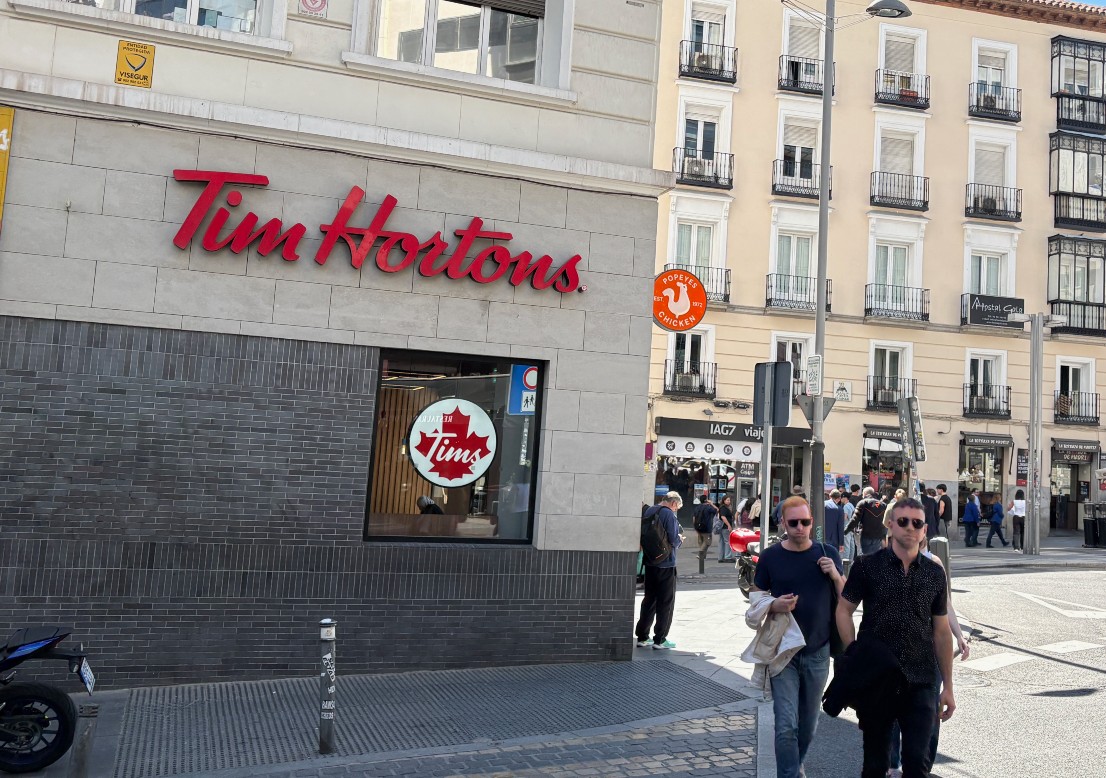
One of the peculiarities of journalism is hewing to a phrase that is the right usage, yet does not appear to be grammatically correct.
An example is the Tim Hortons coffee chain, and another is the Sobeys supermarket chain. What’s missing in each case is some punctuation. The former is named after Tim Horton (and there was only one of him), while the latter is from a family name that is Sobey, not Sobeys.

All this to say … there probably ought to be an apostrophe before or even after the S, but there isn’t. Once in a while, we would get well-meaning audience requests to make a correction.
As for Tim’s — curiously, many Canadians informally call it this, usually with an apostrophe in written use — it certainly didn’t hurt its business opportunities in Quebec, which has a law banning signs in English, to get rid of a tell-tale bit of Anglo punctuation.
In any event, journalists are obliged to type it as the respective companies call it.
Another example, involving quite another kind of organization, is the Hells Angels. It’s not Hell’s Angels, as I had once thought. I only realized this many years ago, when I was editing a document that referenced the motorcycle club (members, for some reason, don’t much like the word “gang”) and assumed the writer had made a mistake.
No, he had not. As a FAQ on the Hells Angels site once revealed, there is no apostrophe. Why?
“That would be true if there was only one Hell, but life & history has (sic) taught us that there are many versions and forms of Hell.”
There you have it.
There are other examples of this type of punctuation. Among them is the E.M. Forster novel Howards End, in which the title refers to the home of the Wilcox family, who are major characters in the book. I that Howards End would be a pretty good sample for a copy editing test. (I remember a Canadian writer joking that putting an apostrophe into the title would imply a very different kind of book!)
There are all kinds of punctuation in brands. I’ve always been intrigued that the W. hotel brand has a conspicuous period after its one and only letter. Some brands with abbreviations lose their periods (hey, IBM) while others, like the youth-focused cosmetics brand E.L.F. keep theirs — in part for the marketing ploy to emphasize eyes, lips and face.
Ambersands are common in branding. Here in Newfoundland and Labrador (I generally use the “and” to join those two place names), the local CBC shows Here & Now and Land & Sea both use them. In the marketing world, they’re also formally used by everyone from Ben & Jerry’s (note that possessive) and H&M to Abercombie & Fitch and Ernst & Young.
Finicky, huh? Welcome to the joy of copy editing.
A last note. The photo at the top shows the familiar Tim Hortons logo, which is iconic across Canada. In this case, it was on a busy street in the Sol district of Madrid.