Leo Barry, the premier who never was

In the coulda-woulda-shoulda world of political speculation, it’s always been hard not to think of the late Leo Barry as a decent candidate for the premier’s office at Confederation Building in St. John’s.
Barry, who died Saturday, was a heavy-hitting cabinet minister in the 70s and 80s — that was him talking about “Texas tea” while cradling a little vial of oil while announcing the discovery of Hibernia in 1979. He was among a generation of passionate, smart Newfoundlanders who came of age in that era and found a home in policy — folks like Cabot Martin, Vic Young, Bill Marshall, Lynn Verge and more. The issues included correcting hydro policy, celebrating Newfoundland and Labrador’s rich culture as an asset not an embarrassment, and aggressively pursuing offshore oil.
Barry and other Tories found themselves under the umbrella of Brian Peckford, who defeated other candidates (including Barry) for the Progressive Conservative leadership in 1979. It wasn’t necessarily the most comfortable place for Barry to be.
I was still in school when a lot of this played out, but I knew Barry somewhat. His then-wife, Mary Barry, was my first English professor at Memorial University, in 1982, and she had a substantial impact on my life. There was something of a circle to this: my dad, Bill Gushue, had taught Mary at university when she was just a teenager, and they stayed in touch. My dad was certain that Leo —like Mary, he was precociously young when he entered university — was destined to make his mark.
He did indeed. Barry had the air of authority about him. He read up on his brief, and took politics seriously. Perhaps a bit too much: I recall him being a little uncomfortable with the more frivolous side of politics. (That said, he wasn’t above getting a new hairstyle once in the early Eighties that can only be described as a perm.)
Barry was responsible for the energy portfolio in those Peckford era years, but he learned he was not actually in the lead on energy policy: that was Peckford himself, the rival who bested him for the premier’s chair.
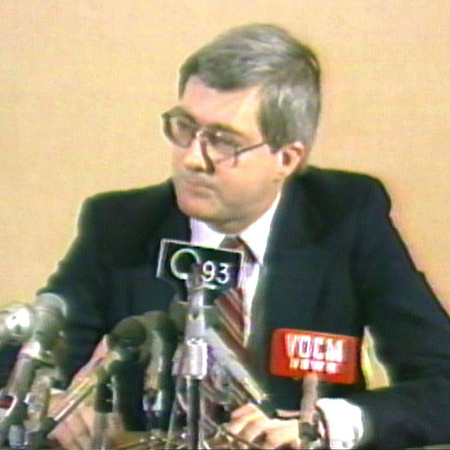
After sniping between the two carried on and on, Barry had enough. He defected to the Liberals in 1984, and by that October handily won the provincial Liberal leadership, defeating Labrador MHA Eugene Hiscock and St. John’s legend Hugh Shea.
While floor-crossings were at that time quite common (hey there, John Crosbie), it’s fair to say that the Liberals never truly warmed to Leo Barry. The party was still in the murk: after the 1982 election, they had just eight of 52 seats. Barry’s job was to get the party ready for the next election.
Peckford, a fan of snap elections, called one for early April, meaning Barry didn’t have even six months to steer the party. Even so, the Liberals practically doubled their vote, and the caucus came out at a respectable 15 members.
Things did not get much better, though, for Barry and the rest of the Liberal caucus.
There was a time in provincial politics in Newfoundland and Labrador — it would be 1987 and thereafter — when the Boston Seafood Show was an ingredient of a good joke. Barry decided to take in the show (a mainstay of N.L. business circles) and left for the week. The problem: he evidently didn’t bother to tell the caucus of his travel plans.
For the caucus, which included then-rookies and future cabinet ministers like Winston Baker, Chris Decker, John Efford, Dave Gilbert and Chuck Furey, that was the last straw. I had a hunch that if it hadn’t been the seafood show, something else would have pushed caucus discontent to the stage of revolt.
Things moved quickly, and Barry threw in the towel. He might have thought he had a chance for a renewed leadership race, but he withdrew that thought.
Behind the scenes, Liberals had persuaded Clyde Wells to return to politics after returning to law after a combative few years (with John Crosbie) against then-premier Joe Smallwood. “Wells in a waltz” was one of the headlines after he handily won the race that June.
Leo Barry continued to sit in the house, and to my recollection, he did not do much else. He did not often speak. He represented the district of Mount Scio quietly until the 1989 election.
He was later appointed to the Supreme Court, first in the trial division, and then the Court of Appeal. It was a fitting place for his intellect to appear.
I had occasional interactions with Leo Barry over the subsequent years. He was always cordial.
On Tuesday, I listed to CBC’s On The Go as reporter Ashley Fitzpatrick (who wrote this obituary on Barry) spoke about his career — and with Brian Peckford about their complicated history. Ministers who clash with premiers are a recurring feature in politics, and it was fitting to remember that era of tumult, too.
A postscript: About a bed
Now that both Leo Barry and his ex-wife Mary are deceased, I can tell an amusing story.
In 1987, I had returned to St. John’s after a couple of years of working in Ottawa. I had found an apartment for Martha and me near Bannerman Park, and was scouting around for furniture … and on a budget.
At that time, Leo and Mary had split, and Mary (not to be confused, by the way, with the talented St. John’s jazz singer) was preparing to move from the family home. I can’t remember exactly how I wound up at her house with my mother that spring day, but my mom told me that Mary might have some things to sell.
And she did. They had a king-sized bed, and at 6’6″, I already knew that was the best size for my extra-tall frame.
I remember Mary laughing heartily out loud as she agreed to sell the bed to me, with one proviso: we were not to tell anyone where what she called her “matrimonial bed” had come from.
And I haven’t, until now.
Mary, who died in 2014 of Alzheimer’s disease, would a little later play a role in my career. I was selling stories to The Sunday Express after moving back home from Ottawa, and when her friend Michael Harris, the always colourful editor-in-chief, told her he needed someone to help with proofing flats (and later copy editing), she told him he already had someone in his stable: me. Michael offered me that extra work, and eventually a full-time job as a reporter.