The Night Logan Woke Up: A family’s trauma is revealed in the embalming room
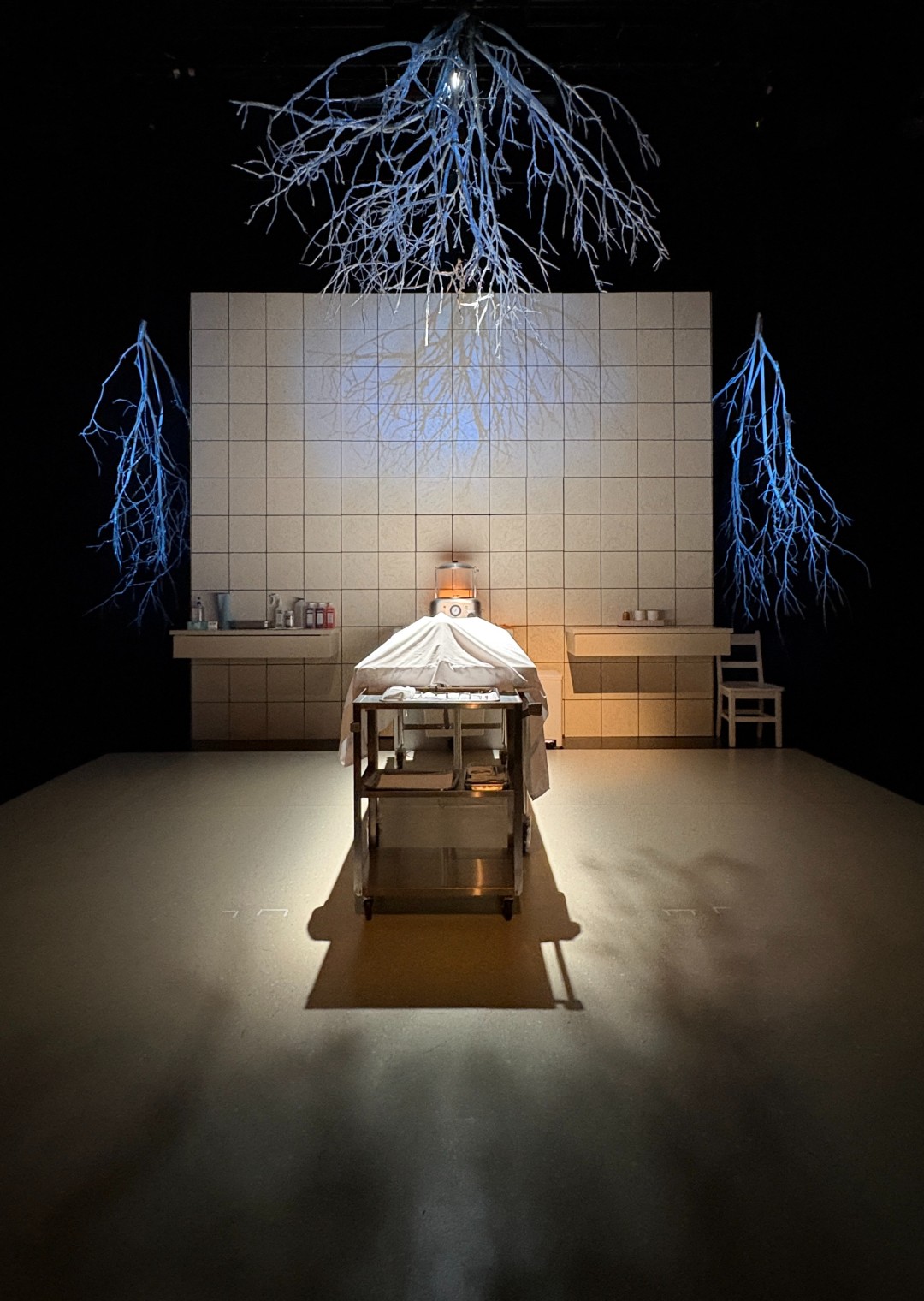
On Thursday night, we went to the LSPU Hall in St. John’s see The Night Logan Woke Up, the latest Artistic Fraud of Newfoundland collaboration between writer Robert Chafe and director Jillian Keiley.
This time, the collaboration extends beyond their usual partners: the production is adapted from Quebec playwright Michel Marc Bouchard’s La nuit où Laurier Gaudreault s’est réveillé, and is a co-production with RCA Theatre and Tarragon Theatre in Toronto.
The setting had been in rural Quebec, and now it’s in rural Newfoundland, specifically Clarenville, a small town about two hours west of St. John’s (or Mount Pearl, which becomes a not insignificant plot point).
The set is clinical and exactingly executed: it’s the embalming room of a funeral home, and Keiley has had it decorated to be both austere and fantastic, with LED-enabled arterial branches that illuminate during the embalming process.
Most family stories play out in kitchens and living rooms. In this case, four siblings and one brother’s wife gather around the corpse of their mother as she is being prepared for a wake. The Lynch family stumble around their awkward situations, accompanied by a young funeral home employee named Megan.
The agent of change is Emilia, the daughter who fled her home to became the embalmer to the rich and famous (and infamous), well enough known in her craft to have warranted a piece in Vanity Fair. Emilia (played by Petrina Bromley) did not make it back home to say goodbye to her mother before her death, and comes with secrets galore packed up with her bespoke embalming kit on wheels. Talk about baggage, indeed.
We learn straight away that as a young girl, Emilia was an insomniac who would spend her nights creeping into neighbours’ houses, observing them. One of them was a teenage boy named Logan, and what happened decades ago when he woke up is what has been driving the family dysfunction.
Much is revealed and disclosed over the two acts. I’ll avoid spoilers for those who have not yet seen the play, which concludes at the Hall this weekend, and which will be staged at Tarragon in Toronto from Nov. 17 to Dec. 13. I noted that the Stratford Festival (where Keiley has directed) was involved in commissioning the play, and I wonder if Chafe’s version will one day land there.
I’d recommend the play. It’s heavy material, and like many family tragedies, there are a lot of lies and horror amid years of suppressed feelings.
In his notes in the playbill, Chafe writes that he was approached to handle the first English-language translation of the play because Bouchard wanted “a similarly unique Canadian locale” akin to the Lac St. Jean setting of the original. In other words, idiom matters, speech matters, identity matters.
I do wonder about Clarenville as the choice of setting. Without giving too much away, I might have gone with another location in the island (I’m thinking of a few choice places in Conception Bay or Placentia Bay) might have better suited the story and what we come to know about the core beliefs and characteristics of some of the siblings. No matter; it does not matter that much.
I did, though, find myself knocked out of the narrative a couple of times, trying to figure out the characters — and how old they were supposed to be. Maybe it’s the casting. Elliot, the youngest sibling (played with great effect, and a lot of comic relief, by Evan Mercer), is young enough to be involved with Choices for Youth, a real organization whose clients are under 30. But the next-youngest sibling is angry Dennis; actor Gordon Patrick White is effective, but he seems older than the rest of the cast. The casting doesn’t derail the production at all, but it did have me stepping outside the moment a few times.
If you have a chance to see the play here in St. John’s, or in Toronto in the coming weeks, take it. It’s very well done.