Soft toys and Velcro: When Alzheimer’s can feel like parenting in reverse
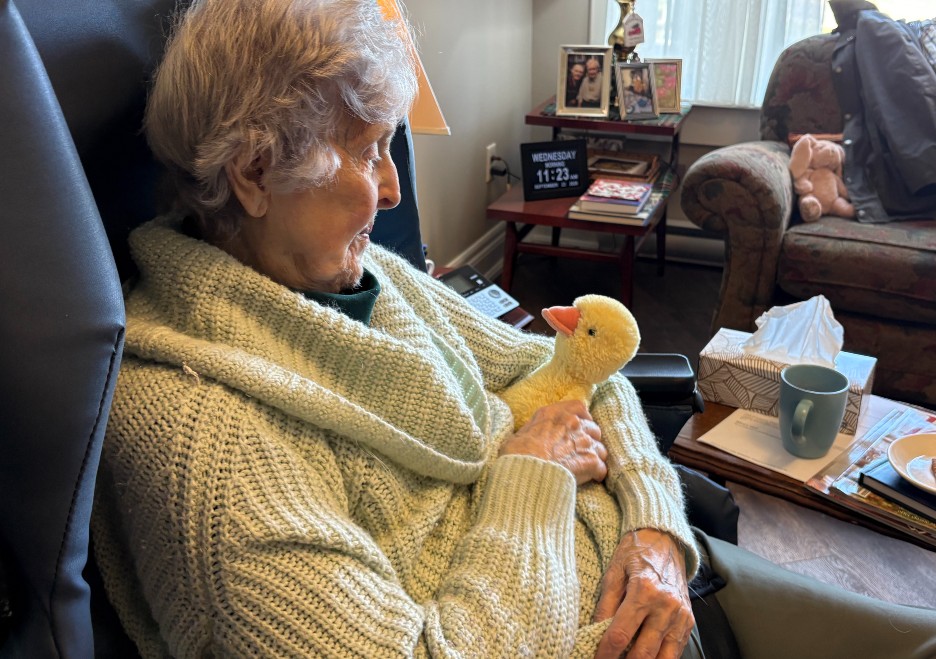
He sits just a few inches tall, has no actual webbing on his feet, and as best I know, he doesn’t hang out with the other ducks in the pond around the corner.
His name is Kenny, and he’s a soft yellow toy. He’s become a key part of daily life for my mom, Sheila Gushue, and he’s by her side — often in her lap or hands — as she lives her life with Alzheimer’s.
I bought Kenny for Mom last winter, after I read months ago about how soft, tactile experiences can be comforting for people with more advanced kinds of dementia. This is where my mom has cognitively been for well over a year now.
I was so grateful that Mom took to Kenny straight away. He’s more than just a source of comfort; he’s her little buddy. “What a good boy you are,” she’ll often say to Kenny as she holds him close, and looks him in the eye.
Many times, Mom is quite aware that Kenny is a toy. But, sometimes, there’s something else.
“John,” she asked me earlier this fall, “how does Kenny get out the window?” As best I could tell, she had been trying to puzzle out that one.
When Mom moved into memory care, we packed up a collection of things from the house, including a teddy bear she had. That bear sits on the bed and is a comfort, too. Kenny is her daytime companion, and just delights and relaxes her. When Mom was in hospital in early September after an injury, Kenny was there — and was something of a star with the nurses and other staff on Mom’s ward. His sunniness became something that everyone loved discussing with Mom. A true mood-lifter.
Kenny is not the only soft in the living room. I also bought a soft bunny for Mom, the kind with long, floppy ears.
Mom named her Estelle, after her best friend. I gulped a bit over that one.
Our house was filled with softs, as our child called them while growing up. Nick was in the initial Webkinz generation, and their room was for a time home to a menagerie of adorable animals. Nick named a lot of them, and I helped out; it took a while for Nick to get the joke of why their dad suggested that their little cardinal be called “Wolsey,” a nod to my interest in Tudor history.
My mom now is the one with softs, and things are similar but very different. Like Nick before her, Mom finds comfort and companionship in these things.
It’s the circumstances that are so different, and I will admit to having echoes of being a parent — echoes which can be a little uncomfortable, and which require some careful thought, too. I’ll get back to this point in detail soon.
Let me give you another example of echo.
This July, I decided to get Mom a new pair of sneakers. This was easier said than done: first, she has long needed orthotic inserts, and second, she had suffered a fall a month earlier, so taking her out to go shopping was off the table. I was grateful to find a local business that let me borrow samples and try them out on Mom in her own room. Through trial and error, we landed on a make and an exact fit, and a special order was placed.
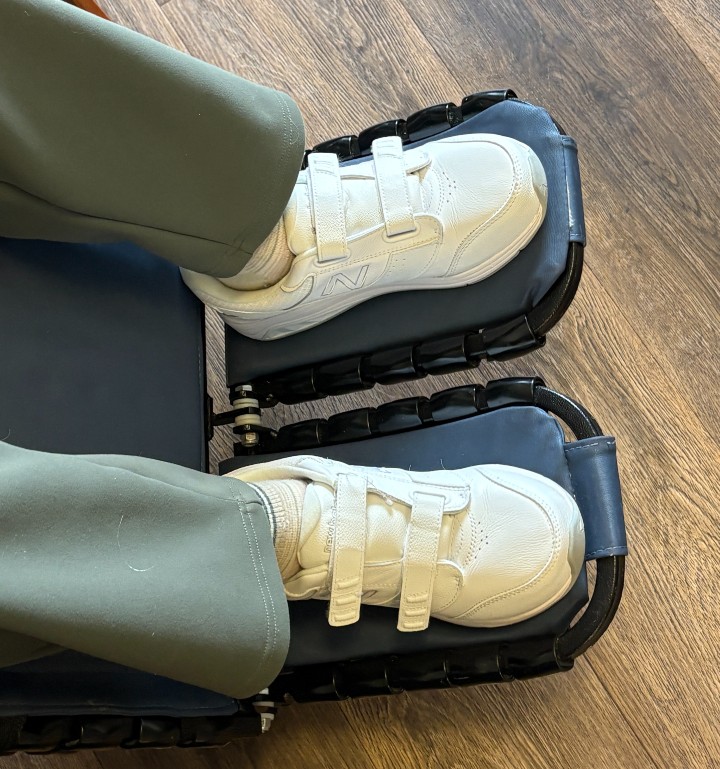
What made it a special order? Velcro.
As parents of young children know, Velcro is a wonderful thing, allowing kids to be safely clothed and outfitted.
The same goes for Mom’s feet. Velcro straps can be easily undone or applied by the personal care attendants who help her with daily living. The sneakers have proven to be super-comfortable and easy to remove.
Twenty years and change after I was helping my kid get the hang of Velcro on their sneakers, I was helping my mom.
Emotional regulation
There are other echoes, too. Take emotional regulation. One of the effects of Alzheimer’s is a declining ability to manage emotions. As the disease progresses, it’s undeniably scary: Mom was quite aware in the earlier stages that she was losing her cognitive powers, and some powerful feelings — anxiety and fear among them — would sweep in. I wrote about this in the opening words of the very first entry of this Alzheimer’s Diary.
I had been through big feelings, as we called them, years ago, when Nick was a toddler. With Mom, I’ve remembered some parenting strategies, although the situation is entirely different.
But it has led me to reflect, and to pinpoint some of the unsettling realities of helping Mom through this disease.
When you’re parenting a child, you know that their ability to manage their emotions will grow stronger.
You know they will learn more, their bodies will strengthen, their minds will sharpen. You know they will become more resilient as time progresses, and more independent.
When a parent has dementia, things typically run in the other direction. Mom is less resilient, and is increasingly dependent.
My mom is not a child
I want to be really clear about something. In no way am I saying that my mom has become like a child, or acts like one.
This is a trap that I think some people might fall into. While some of my situations can feel like parenting in reverse, it’s not the same thing.
Quite a lot has been written about the infantilization of the elderly, and this is particularly so with Alzheimer’s and other dementias. The Alzheimer Society of Canada has published a Charter of Rights for People with Dementia. It emphasizes the dignity of the person with dementia, who “can live as independently as possible and be as engaged as possible in [the] community.”
This is especially important in the earlier stages of the disease. Too often, a diagnosis (even a suspected one) can be accompanied by the loss of agency, of the ability to make or even participate in decisions.
I was fortunate with Mom that even as she sustained a sharp cognitive decline in early 2024, she was very much aware of what was happening, and — even though denial was also a factor some times — she wanted to be involved. I’m also grateful that in that period she brought me into the circle of care with her then family doctor. It made things so much easier that difficult winter.
It does get to be trickier as time passes: Mom was less and less able to contemplate situations and to take part in decisions. This was all anticipated.
Dignity and agency
But we must always remember and respect the dignity and agency of the individual.
I cringed once when a care worker came to Mom with her medications and said, in a jolly way, “It’s time for your candy!” I know that he meant well, and obviously it’s a strategy that has worked for him otherwise, but it left my mother more confused and uneasy. I also found it just plain unnecessary.
As well, my mother is surely not the only person in her situation to be talked over by a professional. Even a few years ago, it was not uncommon for a professional to enter a room and start speaking to me, not Mom. I have heard this kind of anecdote over and over again from other caregivers. Even in her most confused state, Mom deserves to be the centre of attention in a discussion about her care and wellbeing. I am grateful to the doctors, nurses and care workers who style their practice accordingly.
For families and day-to-day life, a lot has been said about the “sandwich generation” — middle-aged adults who have raised (and may still be raising) their own kids, while taking on caregiving for their own parents.
I guess I am trying to be honest in expressing my feelings about the echoes of parenting. My heart is light when I see Mom with Kenny, her little duck. I have no regrets about drawing on some skills and strategies I learned as a parent to help Mom the best way I can, often in the moment.
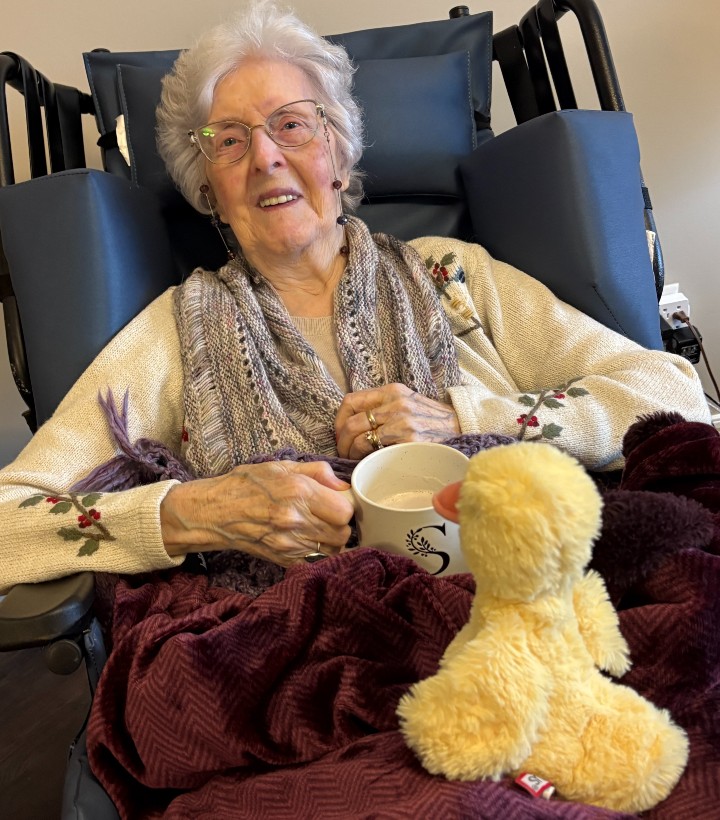
Our parents with dementia are not children. They are adults, in a complicated stage of life.
I also feel fortunate to be able to help my mom.
After all, she is the one who nursed me, hugged me, held me, taught me right from wrong, nourished me, consoled me, gave me so many lessons about the world and how to navigate it on my own.
She cannot navigate this passage on her own. The least I can do now is help her live with comfort and ease, and to provide the same level of care and protection.