Just before I retired, I sent some final advice to my colleagues. Here it is

For most of the last stretch of my career, I was a senior producer with CBC News in St. John’s, and for much of that time, I frequently sent out a note to colleagues in the local shop.
I called it the Digital Note, and the idea was to pull back the curtain a bit, to reveal how our stories and videos were performing, and — much more importantly — to explain tactics and strategies and to shed some insight into audience behaviour.
If information is indeed power (and it is), I’m a strong advocate in sharing information. The more people know, the better equipped they are; as well, the more people you have who know how to things well, the better again for the entire operation.
I have always learned from others who shared their insights and answered my questions, so I made this note a cornerstone of my day. Over the years, it picked up subscribers from other areas and departments of the CBC (it went out as a BCC, or blind carbon copy), and while I imagine that many didn’t read every item, it was always wonderful to get feedback.
So, I spent a little time most mornings putting together my note. My target audience, by the way, was not my own small team. Rather, it was everyone else. As people who work in change management know, it can take a while for people to grasp concepts, change habits, build trust and so on.
In my own way, the note was about charting and making progress, a step at a time.
It was also a way to give feedback — and to celebrate the great work that colleagues do. We often heard from employee engagement surveys that feedback could be better, and I listened carefully to that. Sure, everyone loves a home run, but most games are won through small plays and good, consistent work. It felt important to mark and honour on the work we do every day.
I retired from CBC late last fall. My last day in the office was Oct. 17, and on that morning, I sent out my last digital note.
I decided to make it a bit ambitious, and I put in some of my favourite bits of advice and insights I had gleaned over the years.
I’m including the note here … with some minor edits. (I have removed two small sections, because I intend to build on each of them for a post on this blog.)
One thing I should note: digital news has always been a field that evolves, sometimes rapidly. In a sense, then, this note is a snapshot from October 2025. That said, many of my core beliefs about journalism are, hopefully, a bit more timeless.
Here’s the note.
Digital note: Final edition
Friday, Oct. 17, 2025

This is my last day at the office with CBC News. It’s been an adventure, and a great career. It feels like I’ve had a few of them here, as I’ve been lucky enough over the, yes, decades to work in multiple media lines and on extraordinarily different projects.
This time, as I look back over my career, I want to put the spotlight on some of the topics that mean the most to me, and ideas I believe in deeply.
Audience, audience, audience

Everything we do at the public broadcaster is about the audience. Or audiences, if you like, because the last years have seen remarkable changes in how people consume media and engage with us. On the digital side, the more we know about audience behaviours — and this especially involves analytics and metrics — the better we can be at writing, editing and delivering stories. To paraphrase our former colleague Marissa Nelson, live deeply in the minds of your audience.
Be ambitious
This is a company with a lot going on, and a lot of opportunities. I was helped throughout my career by fabulous mentors, supportive colleagues and bosses, and (here’s a secret) the insatiable demand for content. I put that last point to my advantage, knowing that coming with a pitch that was more solution than problem was always going to help. Put your hand up to learn new and better skills. Volunteer for a different kind of assignment. Take chances with bold opportunities when they come around. Get to know what your leaders want and need — and remember that it’s a two-way street. Let them know you have an idea, say, for a series, for a piece that needs more digging, for a longform or a doc, that you want to try something new (summer backfill is not that far away). Be ambitious. Do things.
Critical thinking
Put your thinking cap on with every story. Ask questions — of yourself, not just your sources. For instance, why does someone want me to know this? Why does someone want me to know this today? What am I not being told? Which voices have we not yet heard? Critical thinking is one of the most important skills in the newsgathering toolbox.
Shoe leather
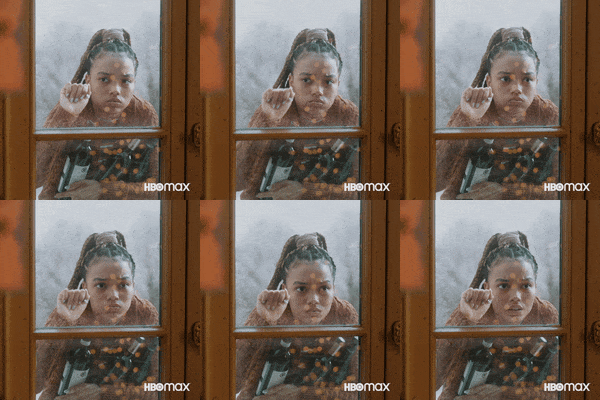
Get out there. Knock on doors. Make calls. Make more calls. Make contacts, and grow your list. I learned about shoe leather — working the story well away from the desk — early on, and I still admire reporters (looking at you, Terry Roberts) who demonstrate it. Some of you may know my distinction between “outdoor cats” and “indoor cats,” and even if you’re the latter and are working the story from your desk, bring a shoe-leather attitude to the job. It’s called “chase” for a reason.
Write together
A lot of our stories have multiple fingerprints, no matter which platform they land on. In digital, even though we individually write alone, the best writing often happens when we team up. Headline writing is a well-known example of my core belief in this principle: in just a few minutes, two or more people can find options that would have eluded me. Take advantage of the folks nearby, and be a good friend to others. Share your gifts.
Learn something new every day

This fall marks 40 years (good grief) since I moved to Ottawa for my first reporting job. What’s kept me going is the hope and intention that I will learn something every day. It happened almost every day, especially when I wanted it to happen. Learning keeps us fresh and alert … and in this industry, that’s an asset. Be curious. Take time to read, to think and to dig. It’s one of the best parts of the job.
Asking for help is not a sign of weakness
It’s a sign of strength. Don’t hesitate to ask someone around you to help you with something. If you don’t understand a technique, a tool, a policy, whatever, ask about it. I wish I had asked more questions and for more help earlier.
Snapper round
Boy, this note is getting long. I’ll wrap it up with some quick bits of advice, a good few of which I’ve dispensed in earlier notes, courses, etc. (Recycling is a good thing, no?)
Your headline is the most important thing you’ll write. Your very best writing needs to go in your headline.
Breaking news is our bread and butter. Exercise your breaking news muscles for when you really need them.
A short conversation with a copy editor early on will save both of you a lot more time.
“Wait, what?!” is a great instinct: when you hear someone else react that way when you talk about a story in progress, or know it inside, lean into *that* element of the story.
Fact, fact, quote, nut graph. This is the basis of what some of us call the Bloomberg model, or a way of opening a digital news story. A strong fact, a supporting fact, your best quote, and a nut graph — the zoom-out moment of a story that explains why it matters. [Ed. This is outlined in a book called The Bloomberg Way.]
Prepare to pivot: The cliche is true … change is a constant. If you also look at other journalists’ careers, you’ll see turns in the road. Be ready to move in a different direction.
Tomorrow is another day. Don’t like your story? It’ll end soon. Tomorrow is another opportunity to do something more satisfying.
Be generous with your colleagues. We live in a business that has stress baked in. Chat with your colleagues, and check in with them, too. Life is short. And how very lucky we’ve been to work in this racket.
It’s been a pleasure and a privilege to be your colleague. You can connect with me at john@johngushue.com.
Cheers,
John