“I learned this lesson too late, frankly: Do not judge it while you’re doing it. Do not go back and fix things that are 20 pages ago when you’re already 20 pages past that. You’ll do that later. Hustle to that finish line, get that thing done.” — Brendan Hunt
He plays Coach Beard on Ted Lasso, and behind the scenes, Brendan Hunt is also one of the show’s writers and key producers.
This quote — some advice for writers for the screen or otherwise — is drawn from an interview he and Jason Sudeikis gave to the trade publication Backstage in 2021.
Most journalists are accustomed to encountering a politician who is thrown by a question, or who seems uncertain while formulating an answer.
Occasionally, though, you get the “deer in the headlights” look, with a politician seemingly unprepared for the entire thing, and at a loss to answer most questions with anything behind the boilerplate talking points drilled into them during a comms briefing.
“Only the mob and the elite can be attracted by the momentum of totalitarianism itself. The masses have to be won by propaganda.” — Hannah Arendt
Hannah Arendt, who had an enormous influence on what people made of tyranny in the 20th century, wrote these words in her 1951 book The Burden of Our Time, which was published in the U.S. and elsewhere as The Origins of Totalitarianism. So many of her insights, about what she witnessed watching fascists before, during and after the Second World War, remains timely.
There is a still a demand for her work. I’ve been waiting since July via the Libby app to read this book through my local library.
We’re having a record-setting time in the St. John’s metro area this month. A few days ago, we passed the mark of 170.2 centimetres of accumulated snowfall, making it the snowiest February since record-keeping got underway.
We’ve definitely been having intense feelings: snowfall after snowfall after snowfall, it all adds up. Schools were closed for three days this week (a bit longer than some parents would like) so that crews can widen streets and dig into sidewalks where kids need them most. (There is an awful lot left to do.)
We’ve had worse winters. A record-keeper for the whole season was in 2000-2001, when a staggering 648.4 centimetres dumped down over consecutive months. That December alone was a record-setter. What I remember also is that the snow just kept piling up and up and up.
“The great advantage of having a reputation for being stupid: people are less suspicious of you.” — Richard Curtis
These words come out of the mouth of Tom, the richer-than-rich, loyal and slightly daft friend in the Four Weddings and a Funeral ensemble.
Tom was played by James Fleet, who a few months after the release of Four Weddings in 1994 went on to play a similar role: Hugo, the lovable richer-than-rich parish council member in The Vicar of Dibley, destined to be dogged by his boor of a father and loved by Alice, the slightly (well, maybe very) daft verger.
That show was also written by Richard Curtis, who has long had a way of slipping wisdom into his funny lines. Curtis has had a legendary career: creating Mr. Bean with Rowan Atkinson; creating and writing the Blackadder shows (another Atkinson star turn); writing and directing Love Actually, which comes around every Christmas; and helping to launch Red Nose Day and Comic Relief, both of which are still going concerns. One of my favourite of his movies is About Time, which has a father-son theme that is more resonant now that my own dad is gone.
Beirut is the band in which Zach Condon expresses his ideas, or gets a few things out of his system. Like, say, divorce.
Perth is a song released on Beirut’s album No No No in 2015; hard to believe a decade (and more) has gone by. It’s a song Condon said was inspired by being in Australia, and feeling like he needed to get out of his head.
Last night I combed the earth
You saw me at my worst
Ragged tires burn for miles
I ran until it hurt
“Curious things, habits. People themselves never knew they had them.” — Agatha Christie
Composed for the short story Witness for the Prosecution (later a play, and later adapted several times for the screen), this insight from Agatha Christie is just one revelation of human nature in her work.
I have written plenty of obituaries over my time, and by that I mean news stories about public figures whose lives were remarkable. I also wrote or edited many articles involving death.
There’s a language preference that I have that I know strikes some people as cold. I generally wrote that someone died, plain and simple. Like many journalists, I don’t much care for a phrase like “pass away.” It’s a euphemism.
“Died” is not rude, nor is it unnecessarily blunt.
It’s factual. It’s true. It’s also a clear, fair way to write about a subject.
By the way, I don’t object to when I hear others say something like “passed away” in conversation. Indeed, my wife and I found it charming when a financial planner used the phrase “meeting the angels” as a wink to an inevitable part of the process.
But in writing, for me, it’s best to be clear and straight forward. In the same way I respect medical examiners who strive for identifying truth in death, I feel journalists should be factual in what we write.
This point is made in various journalistic style guides. The CBC Language Guide (which I used for many years) is in line with other newspapers, broadcasters and wire services, including The Associated Press, which once put it this way in a post: “While many people use softer phrases like passed on or passed away, AP style does not use such euphemisms except in direct quotations. We suggest being clear and direct with the words death or died.”
“It is very well known that you learn more from failure—when things are not working well… It is very important not to focus on success—it’s so rare. If you want instant gratification, don’t be a scientist, because you won’t get that. You try many things and you don’t know whether something is doable or not. But this is being a scientist. We are doing things that nobody has done before, and we don’t know whether it is possible.” — Katalin Karikó
A Nobel laureate, Katalin Karikó has certainly known both failure and stunning success. I read her memoir, Breaking Through: My Life in Science, earlier this year, and found her story absorbing, even though I knew the broad strokes from media coverage over the last five years.
Born in rural Hungary, Karikó eventually came to the United States, but ran into indifference and worse as she persisted in exploring mRNA.
Here’s a quick look at some podcasts that might be worthy of your ears.
I’m really looking forward to reading the new novel from St. John’s writer Sharon Bala. Good Guys evidently takes a swipe at the international aid racket, and involves a fictional Toronto-based organization working in a fictional Latin American nation.
On her podcast Shelf Esteem, Trudy Morgan-Cole sat down with Bala, who noted that some of the roots of the novel come out of her (very different, fortunately) experiences working in communications for non-profits. Those experiences were not the stuff in the novel, but as she says, “It’s difficult to see how the sausage is made and never knowing that again.”
“Bureaucracy defends the status quo long past the time when the quo has lost its status.” – Laurence J. Peter
Born in Vancouver, Peter found fame in the United States, and became well enough known that one of his inventions — the Peter principle — has long outlived him. A bestseller after its publication in 1969 (Laurence teamed up with writer Raymond Hull, who turned his ideas into a manuscript), The Peter Principle held (as a paperback version put it) that “every employee tends to rise to his level of incompetence.”
Subsequent research has shown that there’s something to it; some researchers found, for instance, that people great at sales can make for poor choices as managers.
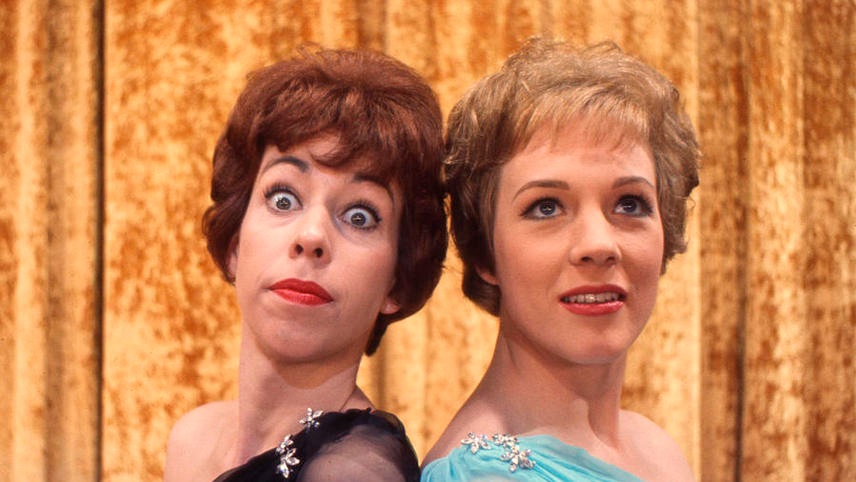
Amy Poehler must surely have been excited to have had Carol Burnett on her podcast Good Hang. In an episode that was released early this month, the comedy legend sat down for an expansive conversation about growing up (literally in the shadow of the Hollywood sign, which she played on like a playground), making the show of her own name (some of it does not hold up, she says) and still having a career in her 90s.
There are a lot of anecdotes, like this one, when she was the toast of Broadway in Once Upon a Mattress, and she was told she should connect with a young Brit named Julie Andrews:
I was doing Mattress, and she was in Camelot. So she was a queen and I was a princess. And some friends, mutual friends, said you two ought to meet. Because there’s a similarity there…
Anyway, she had Sunday night off from Camelot, and we worked on Sunday night. So she came with her friend, and I had my friend there, the two gentlemen, just friends. And she watched Mattress, and we went out to a Chinese restaurant afterwards, and we never stopped talking to each other.
The poor guys who were with us just sat there and listened. It was as if we were joined at the hip from the beginning, and always. And she taught me some dirty words.”
“Fortunately, there is more to life than death. There is for one thing, fiction. A thousand thousand characters to be sent marching out into the world to divert time from its forward gallop to the terrible horizon.” — Fay Weldon
The British novelist Fay Weldon has long been one of Martha’s favourite writers; she included her work in her Master’s thesis, and books like Down Among the Women (the book from which today’s quote originated) were introduced to me when we started going out.
Roger Charlson was born in Birmingham on Feb. 21, 1963, and was still a teenager when his band — the Beat, or the English Beat, as we knew them in North America — started clocking out ska-inspired hits. Ranking Roger, whose parents were from Saint Lucia, was the toaster along singer Dave Wakeling, and was the focal point even when he wasn’t on mic.
Here’s Roger leading the Beat at the US festival in California in 1983, with Ranking Full Stop:
The Beat were ambitious in just three albums, which came along quickly: ska, reggae, new wave, guitar pop, a bit of calypso and Roger’s own taste for reggae. I still regularly play songs like Mirror in the Bathroom, Too Nice to Talk To, Stand Down Margaret and I Confess, among others.
I wonder if there are many shared smiles between John Risley and Brendan Paddick these days, as the two of them deal with separate court actions — one in which they are pitted against each other, the other in which they are accused of enriching themselves at the expense of investors — in two separate provinces.
Risley is fighting in Nova Scotia court for the future of his investment firm, trying to keep his creditors at bay. One of the people chasing him in court is Brendan Paddick, who made his own fortune in the cable industry in rural Newfoundland, and who has been a business ally to Risley for at least a couple of decades. (Paddick has many other connections, too; he founded the Dollar A Day Foundation with singer Alan Doyle and former N.L. premier Andrew Furey.)
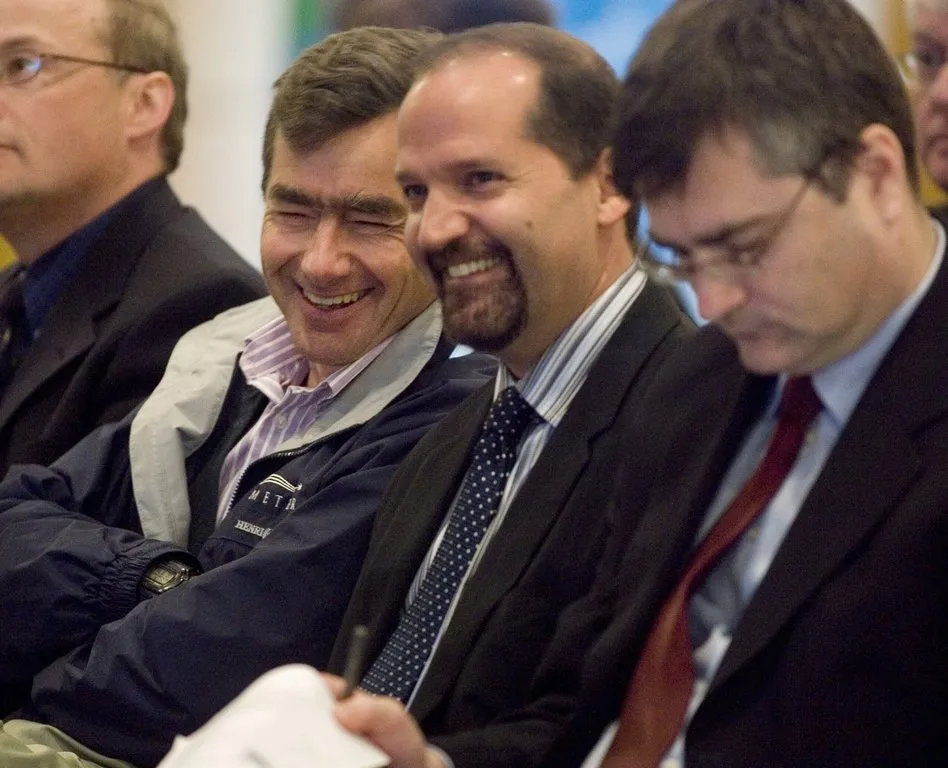
The photo above was taken by the venerable Canadian Press photographer Andrew Vaughan in 2007, at a shareholders meeting for Clearwater Fine Foods. That’s Risley on the left, and Paddick smiling by his side.
CFFI Ventures Inc. is the successor company that Risley founded, and its current problems are mighty, if not staggering. It emerged this week that CFFI owes more than US $776 million.