It’s a clever “what if” conceit, a plot theory to upend one of the great narratives of modern fiction.
What if Sherlock Holmes and James Moriarity, deathly rivals in the work of Arthur Conan Doyle and countless adaptations, were … friends?
At least, that is, they start out as buddies. That’s the premise of Young Sherlock, a Guy Ritchie-backed series that debuted last month on Prime, and which features Sherlock Holmes coming of age and meeting a rascal student in Moriarity.
“Be pitiful, for every man is fighting a hard battle.” — Ian Maclaren
This quote has a bit of history since the Scottish writer Ian Maclaren contributed it to the nonconformist religious publication British Weekly in 1897.
It travelled within months across the Atlantic, and through the years has evolved into other wording, primarily “Be kind, for every man is fighting a hard battle.”
Historica Canada posted something of note yesterday on Facebook: a new Heritage Minute is coming, and it’s about Gander and 9/11. In a starring role: Rick Mercer, as former Gander mayor Claude Elliott.
It’s a well-known story already: residents of Gander and neighbouring communities welcomed about 6,000 stranded travellers when American airspace was shutdown after the terror attacks on Sept. 11, 2001. The musical Come From Away played for more than five years on Broadway, and is still performed around the world.
“The bad times I can handle. It’s the good times that drive me crazy. When is the other shoe going to drop?” — Erma Bombeck
This feels like the credo of a pessimist, or maybe a realist.
Whichever shoe fits, Erma Bombeck occupied some prime real estate in hundreds of newspapers for a great many years.
At her peak, in the 1970s, her syndicated humour column At Wit’s End was reaching an estimated 30 million readers. (To put that number in perspective, those numbers were similar to what episodes of All in the Family and the Mary Tyler Moore Show were typically getting in that era.)
“I think I learned years ago that you don’t get songs that have that long stride and that pivot-hinge ability if it’s too much diary entry.” — Leslie Feist
Feist made this observation about her songwriting technique — moments before, she acknowledges “there is always an innate bit of autobiography there” — in a 2007 interview with the New York Times.
This was just before the release of her breakthrough album The Reminder, and indeed right as she was about to shoot the video of 1 2 3 4, the song that pushed Feist right smack into the mainstream.
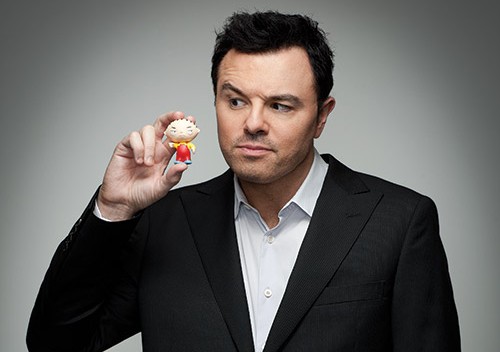
“My thought is always, ‘It’s only downhill from here.’ That’s how I’ve always operated, ever since I began Family Guy. I had the crippling fear that I used up all the funny last week. That crippling insecurity really drives you to do your best. … Your moments of pure joy are few and far between, but they do exist.” — Seth MacFarlane
The creator and driving force behind Family Guy and other projects, not to mention the voice of Stewie, Peter and other characters, Seth MacFarlane made this comment in 2012 when he was being interviewed at an industry forum in West Hollywood around the time he hosted the Oscars that year.
Surely that kind of gig would be a feather in any entertainer’s cap. I find it remarkable that MacFarlane, with a bevy of talents, is dealing with insecurity that can feel threatening.
Earlier this week, I put the first line of clothes of the year out on the line. Now it’s spring, I thought to myself. I made a quick post on social media, and hours later, I was surprised to see that several dozen of people had engaged with the post on Threads.
Flattered, I thought … but it’s just laundry, right?
There is something about a clothesline, though. The one you see above is from last August, when I hung a batch of shirts out, and the early morning sunshine was sublime.
It’s no coincidence that the humble clothesline has been a recurring motif for Newfoundland and Labrador’s celebrated tourism ads over the years. Indeed, the whole genesis of the campaign rests in the fact that in some parts of Canada, clotheslines are verboten.
“The sea can swallow ships, and it can spit out whales like watermelon seeds. It will take what it wants, and it will keep what it has taken, and you may not take away from it what it does not wish to give.” — Natalie Babbitt
Living in Newfoundland, and just a short drive from the coastline, I’ve had a lifelong appreciation for the sea. It has its own magic and lore, and so often, there is also tragedy — a reminder of the ocean’s relentless power. That pain is present in the folk songs we sing, the tales we tell.
Martha Muzychka making some delicious spinach pasta.
On the weekend, Martha and I drove to Cape Broyle — about an hour south of St. John’s — and spent an afternoon learning how to make pasta. It was one of the best things we’ve done together in quite a while.
The pasta course is one of the things that The Cape has been offering as it gets ready to open its high-end cabins this summer. The cabins look to be pretty luxe, and I take it are aimed at tourists from away (hey, Ontario) who are looking for a cosy-rustic experience while scooting around St. John’s and eastern Newfoundland.
“I am much fonder of receiving letters, than writing them: but I believe this is no very uncommon case.” – Mary Lamb
Known most for retelling (with her brother, Charles) the plays of William Shakespeare into stories for children, Mary Lamb was also an inveterate writer of letters, some of which were collected and published decades after her death in 1847.
Her own life was marked by pain, mental illness and tragedy; she fatally stabbed her mother in 1796.
“I’m just thinking about making people laugh. I hate when guys talk about ‘I’m edgy.’ The worst comics think that way. It’s not edgy if you’re talking about it! You just live it.” — Chris Rock
Chris Rock is perhaps the most famous comedian or comic of my generation. We were born a few weeks apart, and grew up in completely different circumstances. I grew up in a homogenous bubble of eastern Newfoundland, and Rock grew up in Brooklyn, one of the first Black kids to be bused to a white school.
Polling data from the last few days speak to a few things. First, Canadians are getting increasingly anxious about economic matters. Second, none of that is hurting Mark Carney — at least, not yet.
There’s a conventional wisdom that economic indicators — and not just that, but public perception of them — are tied directly to a political success and failure.
It’s not always that simple or straightforward, though, and right now Canada’s Liberal prime minister has not been dragged down by an economic gloom that threatens to push much of the world into recession.
It’s enough, indeed, to make me wonder if Carney’s greatest opponent right now is not any individual in Parliament, but economic forces outside.
“I don’t think people listen with their ears. I think they listen with their soul.” — Herb Alpert
I heard Herb Alpert — the legendary trumpet player, producer and career-maker — say these words in the documentary Herb Alpert Is…, which is currently streaming on Tubi.
Early in the documentary, we’re reminded that Alpert accomplished something that later generations might find hard to believe. He was so successful around 1965 and 1966, he was outselling the Beatles.
For Gen X folks like me, a few bars of some signature tunes like Spanish Flea are shorthand for an era of kitsch, plastic and questionable taste. But I actually do like his playing, and (Dad puts on his cardigan for this part) some of those Sixties records actually sound pretty good.
“It seems like only yesterday that savers were dorks. They kept piggy banks. They drove last year’s cars. They fished in their change purses for nickels while the superstars flashed credit cards. Today, values have changed. The new object of veneration is not money on the hoof but money in the bank — and the dorks all have it.” — Jane Bryant Quinn
The financial commentator Jane Bryant Quinn made that observation during a recessionary time … the early Nineties, to be exact, in the book Making the Most of Your Money.
This was a work she would revise or update through the years, which makes sense, because practical advice about money never really goes out of style.
“There is a cult of ignorance in the United States, and there has always been. The strain of anti-intellectualism has been a constant thread winding its way through our political and cultural life, nurtured by the false notion that democracy means that ‘my ignorance is just as good as your knowledge.” — Isaac Asimov
These words from Isaac Asimov, the noted author and writer, first appeared in January 1980 as a My Turn column in the American magazine Newsweek. My Turn was a pillar of the magazine, showcasing a different guest column each week.
Asimov, though best known as a science fiction author, was also passionate about public understanding of science, and took advantage of the opportunity to argue that the right to know is meaningless if so many people are ignorant. (And, yes, more than three decades before the MAGA movement, he critiqued how gaining knowledge and checking facts were being dismissed as activities of “the elite.”)